Glendo High School in Platte County enrolled one student in the 2025-26 school year.
One student in a building that held 35 in 2001. One student in a community 90 miles north of Cheyenne with a population under 200. One student in a state where 19 schools now operate with fewer than 10 enrolled.
It is an extreme case — but in Wyoming, the extremes tell the story.
The smallest schools in America's least populated state
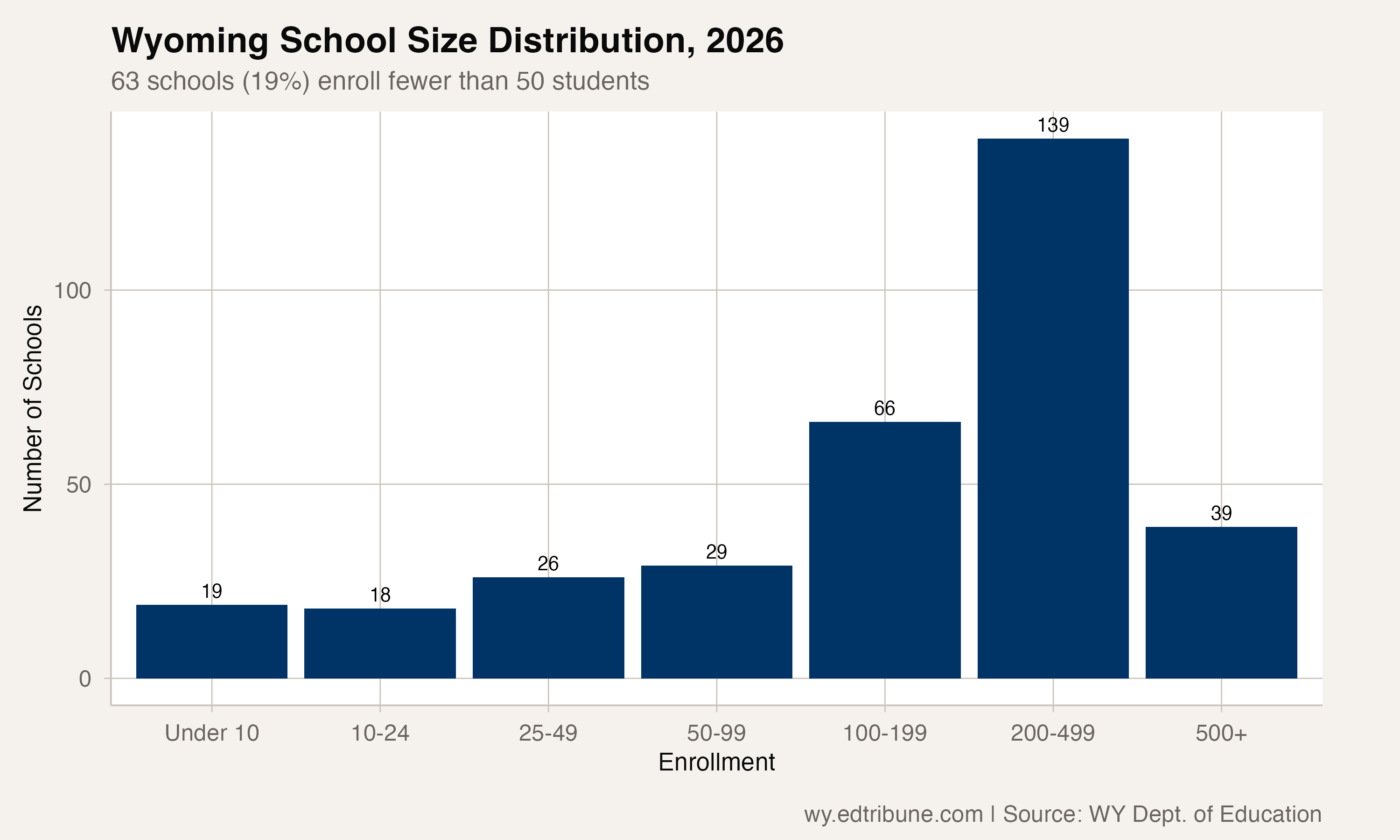
Wyoming operates 336 schools across a state with fewer people than most mid-size American cities. Sixty-three of those schools — nearly one in five — enroll fewer than 50 students.
The smallest are scattered across ranch country and reservation land. Antelope Creek School in Albany #1↗ET has two students. Notch Peak Elementary, also in Albany County, has two. Crowheart Elementary in Fremont #6↗ET, near the Wind River Reservation, has two. Bondurant Elementary in Sublette #1↗ET, a ranching community in the Upper Green River Valley, has three.
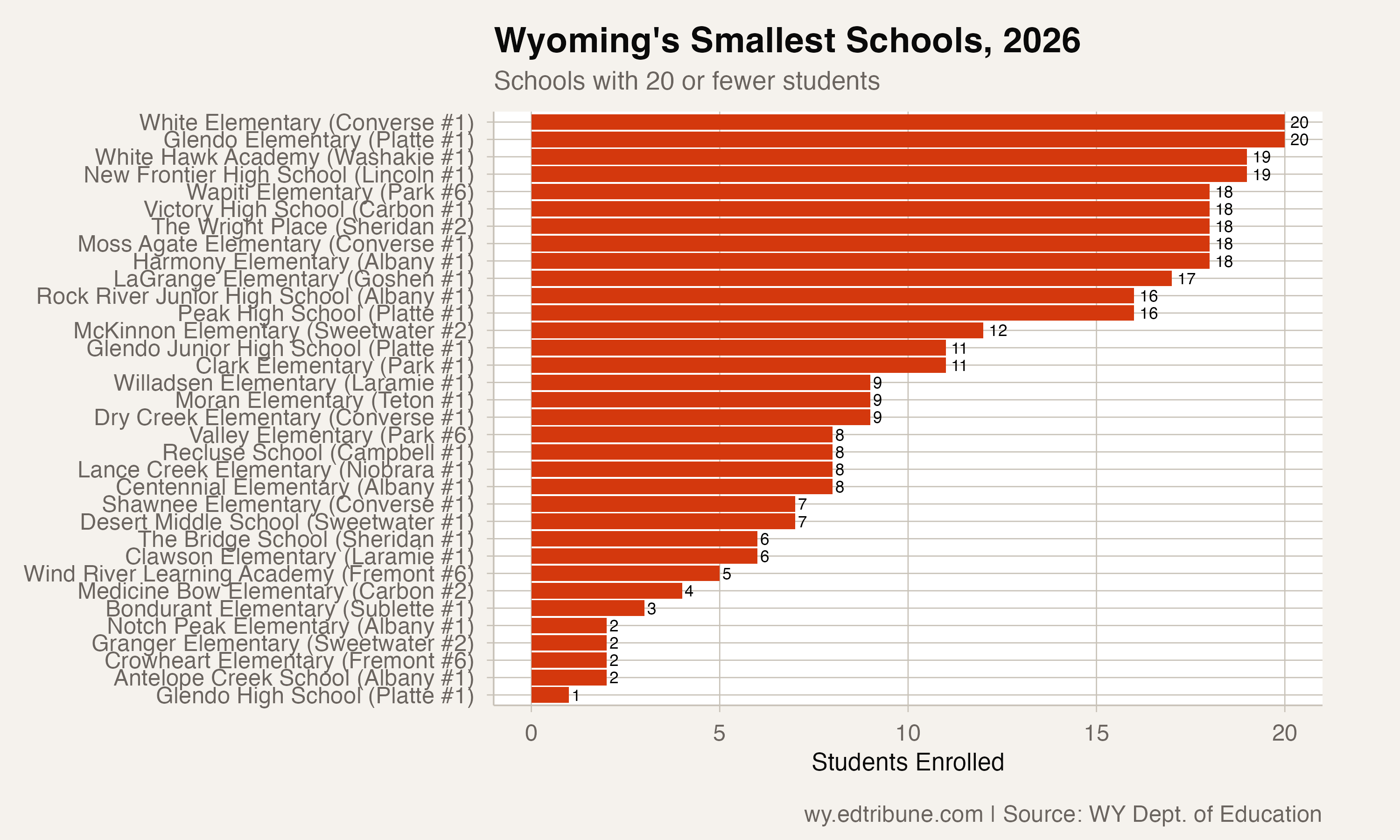
Nineteen schools have fewer than 10 students. Thirty-seven have fewer than 25. These are not charter experiments or alternative programs — they are the primary schools serving communities where there simply are not many children left.
Glendo's slow decline
Glendo High School's arrival at one student was not sudden. In 2001, the school enrolled 35 students. By 2008 it was down to 16. It hovered in the teens and low twenties through 2018, dropped to 12 in 2019, and reached 8 by 2023. In 2024 and 2025, it appears to have reported no enrollment at all. In 2026, a single student is enrolled.
The elementary school down the road has held on somewhat better — 47 students in 2001, 20 in 2026. The junior high hit zero in 2023 but rebounded to 11 in 2026, suggesting a few families remain. The combined Glendo complex now serves 32 students, down from 98 a quarter century ago.
Platte #1↗ET (Wheatland), the district that includes Glendo, has been on an eight-year decline streak — the longest active run in the state. It dropped from 1,014 students in 2019 to 811 in 2026, a 20 percent loss.
Forty-six schools lost in 25 years
Wyoming had 382 schools in 2001. By 2026 it has 336 — a loss of 46 schools over 25 years.
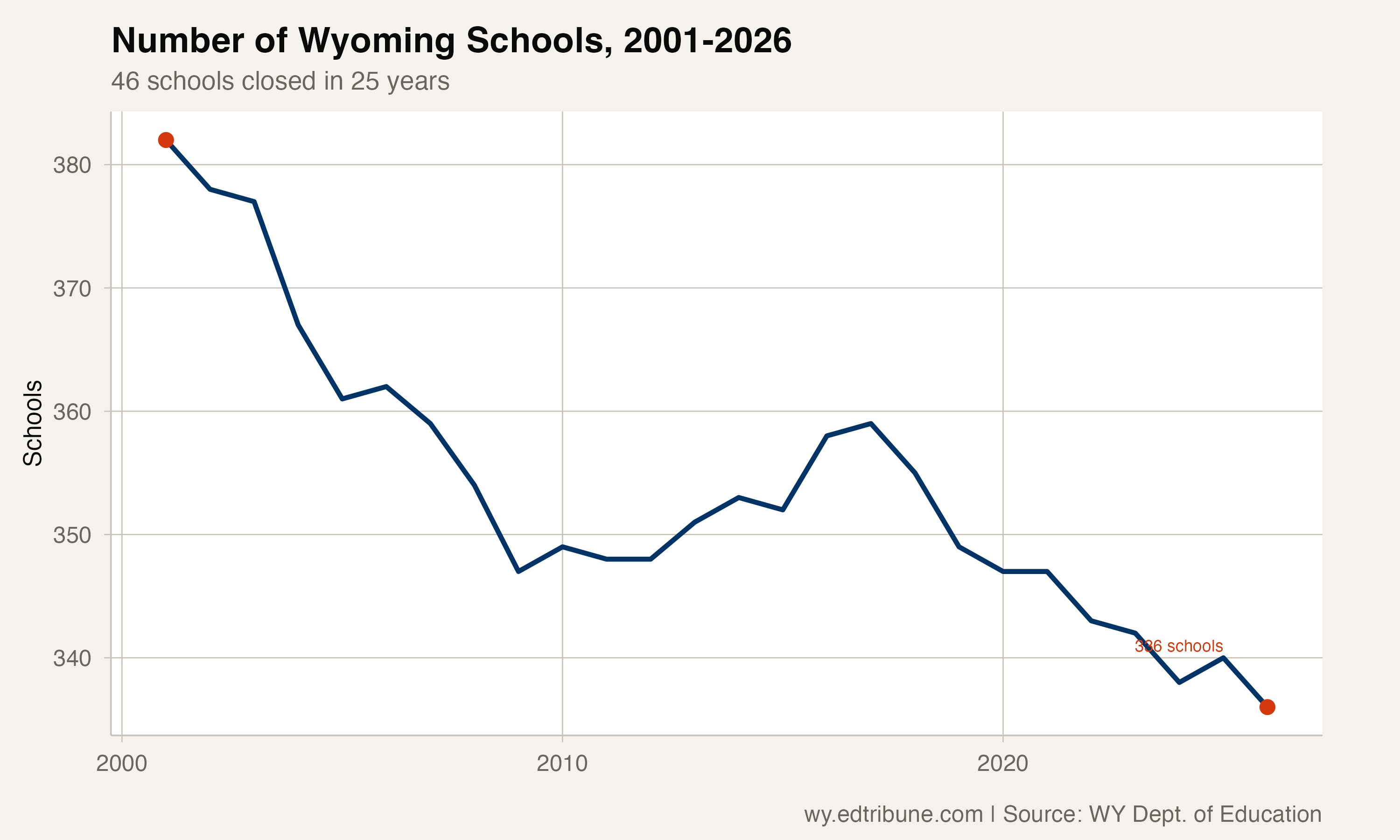
The closures have come in waves. The early 2000s saw the sharpest drop — 21 schools lost between 2001 and 2005, coinciding with an enrollment decline of 6,293 students. A brief stabilization during the energy boom gave way to a second wave of closures after 2016.
Now a third wave is beginning. Laramie #1↗ET (Cheyenne) has announced plans to close eight elementary schools through 2035. A district consolidation bill has been filed in the legislature. The pressure to restructure a system built for 94,000 students to serve 87,000 — and soon fewer — is growing.
The cost of keeping small schools open
Wyoming's school funding formula, the School Foundation Program, ties dollars directly to student headcount. Every lost student means less money. For a school like Glendo High, which now generates funding for a single student, the economics are stark.
Yet these schools exist for a reason. In a state where the nearest alternative school may be 60 miles away on a two-lane highway, closing a school doesn't just consolidate costs — it removes the institution that anchors a community.
Seven districts — Sheridan #3↗ET (77 students), Park #16↗ET (90), Washakie #2↗ET (108), Platte #2↗ET (185), Fremont #2↗ET (195), Big Horn #4↗ET (225), and Fremont #6 (321) — each serve entire geographic regions with fewer students than a single large school in Cheyenne or Casper.
Wyoming's smallest schools are not failing. They are serving the students who remain in communities where the population has been declining for decades. The question is how long the state can sustain a system where one in five schools has fewer than 50 students — and some have fewer than five.
Detailed code that reproduces the analysis and figures in this article is available exclusively to EdTribune subscribers.
Discussion
Sign in to join the discussion.
Loading comments...