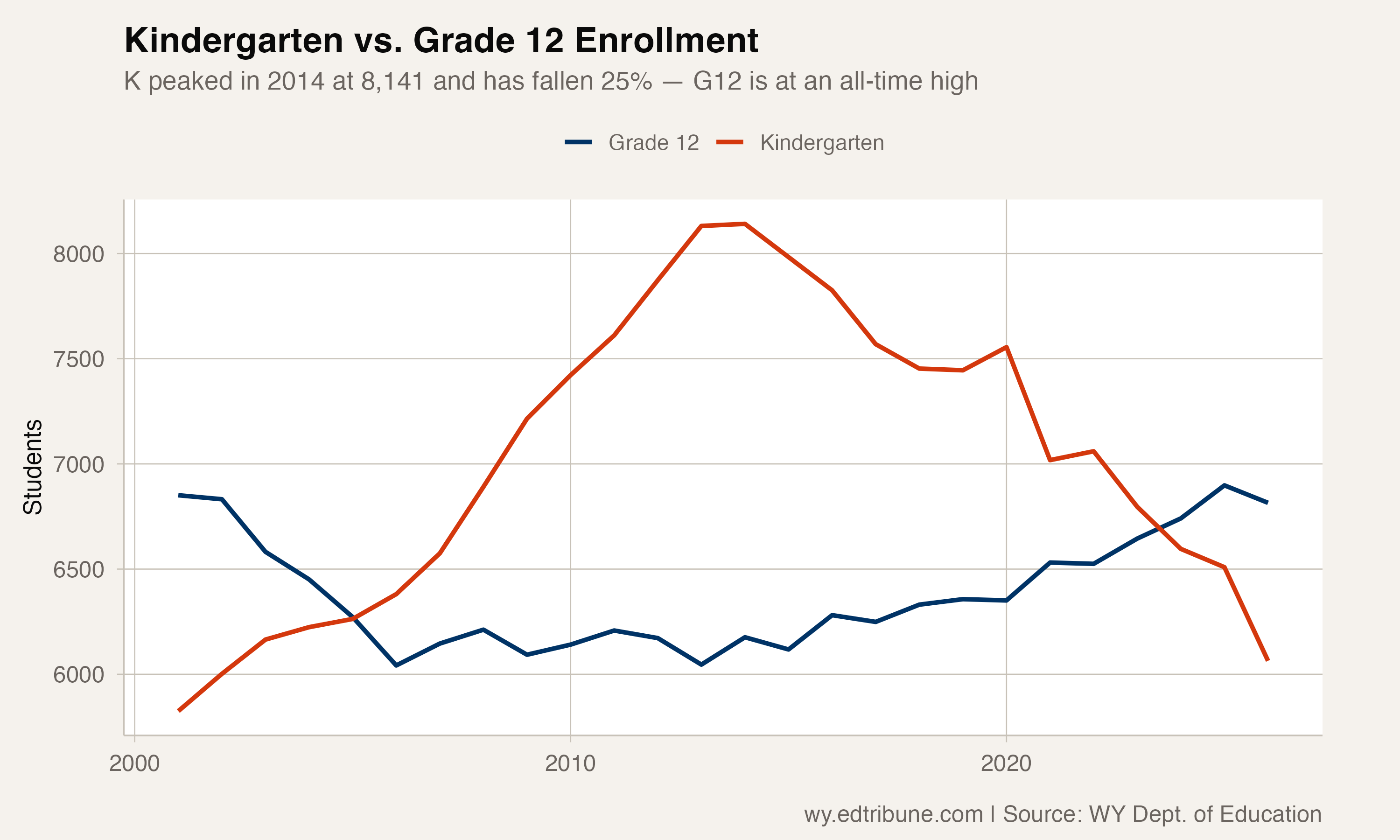
Wyoming enrolled 6,064 kindergartners in the 2025-26 school year. That is 25.5 percent below the 2014 peak of 8,141, and the lowest kindergarten enrollment since 2003.
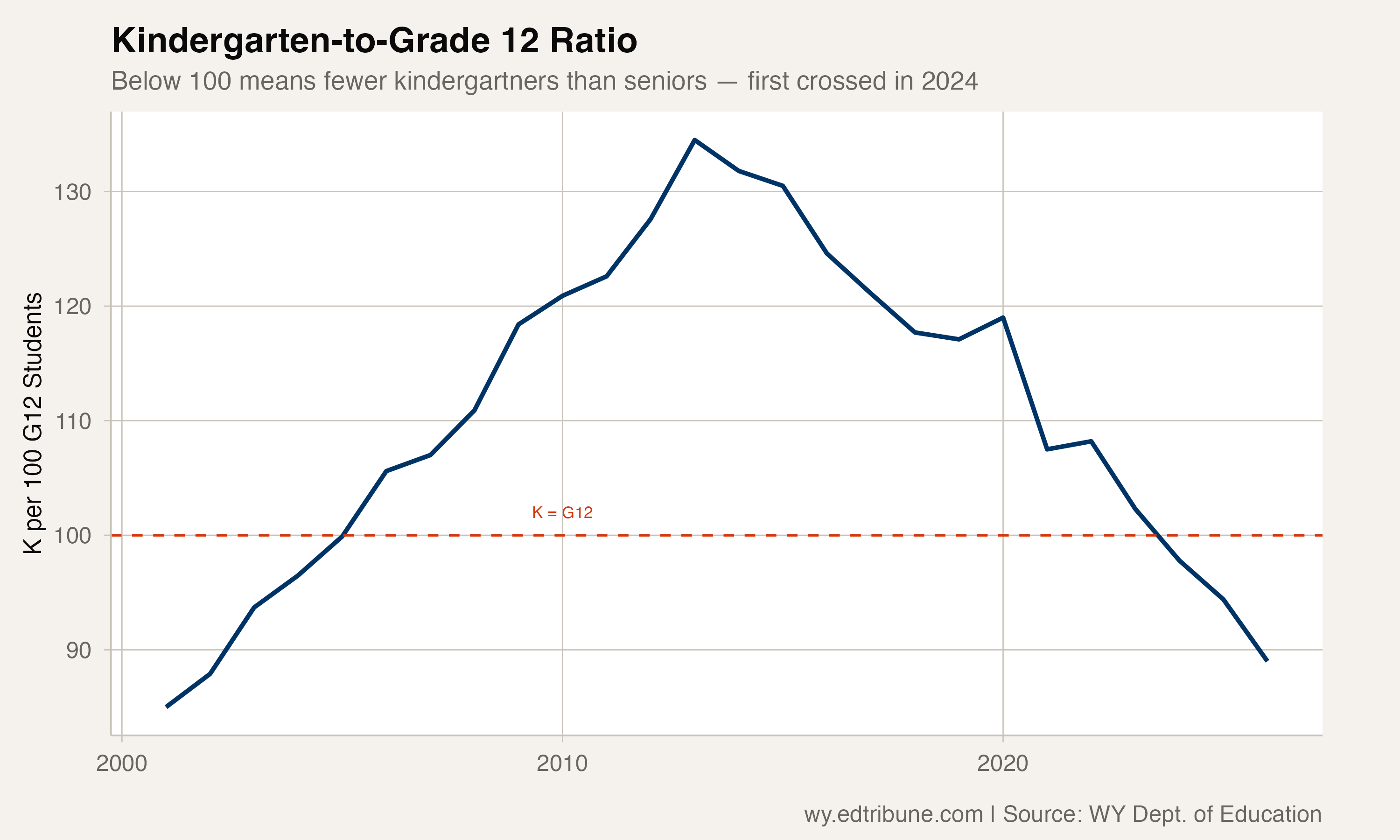
The same year, Wyoming enrolled 6,815 seniors. For the third consecutive year, Grade 12 outnumbered kindergarten — a ratio of 89 kindergartners for every 100 seniors. The inversion signals that the large cohorts from the energy-boom years are finishing high school, and the classes replacing them from below are dramatically smaller.
The pipeline math
Kindergarten enrollment correlates at r=0.97 with total state enrollment three years later. When fewer children enter kindergarten, total enrollment follows within a few years, as reliably as anything in education data.
Wyoming's kindergarten peaked in 2014 at 8,141 — the tail end of the energy boom that brought young families to extraction communities. Since then, K enrollment has fallen in 10 of 12 years. The decline accelerated in 2026, when 445 fewer kindergartners enrolled than the previous year — a 6.8 percent single-year drop.
The K-to-G12 ratio tells the story in one number. In 2020 it was 119 — for every 100 seniors, there were 119 kindergartners entering the system. By 2023 it was 102. In 2024 it dropped below 100 for the first time since the pre-boom era, and by 2026 it stands at 89.
A pipeline that filled, then drained
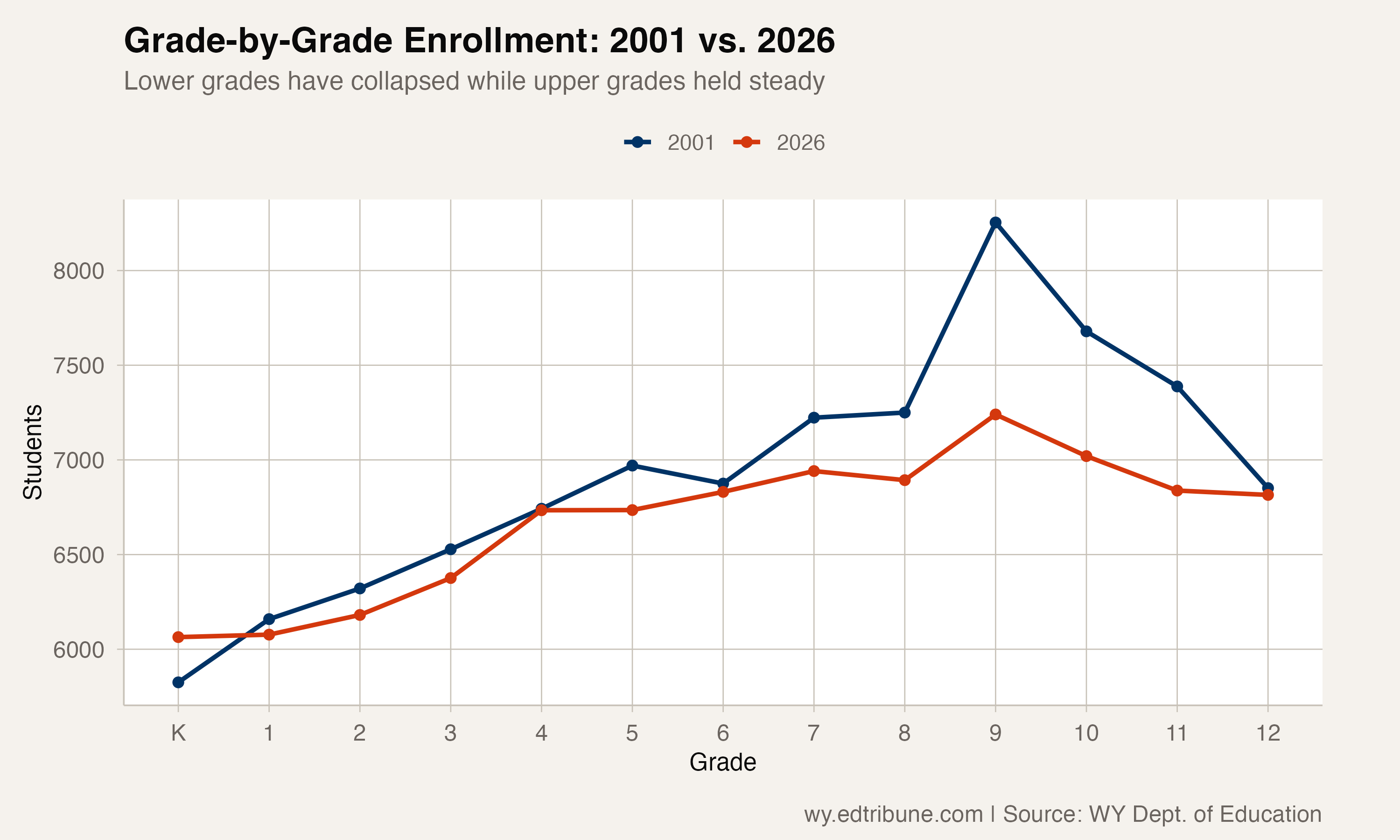
The grade-by-grade profile of Wyoming's enrollment looks dramatically different than it did 25 years ago. In 2001, kindergarten was the smallest grade in the system at 5,825 students, and the high school grades fanned out larger above it: 8,254 ninth graders, 7,679 tenth graders, 7,388 eleventh graders. Wyoming was running off the back end of an earlier population dip, and the elementary pipeline was thin.
The energy boom that began in the mid-2000s filled the pipeline from the bottom. Kindergarten grew almost every year from 2001 through 2014, peaking at 8,141. Those large classes are now graduating: Grade 12 hit an all-time high of 6,898 in 2025, with 2026 close behind at 6,815.
But the elementary cohorts that should be replacing them have shrunk back toward 2001 levels. Grades 1 through 8 in 2026 each have fewer students than the corresponding grade in 2001 — and several are well below it (Grade 8 down 357, Grade 7 down 282, Grade 5 down 235). Kindergarten is the lone exception, and only by 239 students over a 25-year span. The pyramid Wyoming built during the boom is hollowing from the bottom up.
The aggregate tells the same story. K-8 enrollment peaked at 67,159 in 2016 and has fallen to 58,832 in 2026 — a loss of 8,327 students, or 12.4 percent. High school enrollment over the same window edged up from 26,843 to 27,913, about 4 percent, as the boom-era cohorts moved through. K-8 is shrinking at roughly 1.6 times the rate of total state enrollment over the past decade, which is what you would expect when the loss is concentrated in the lower grades.
The temporary reprieve is ending
Wyoming's high schools have been insulated from the state's enrollment crisis because they are graduating the large boom-era cohorts. Grade 12 reached an all-time high of 6,898 in 2025. But this is temporary.
The kindergarten classes of 2021-2026 — all under 7,100 students — will reach high school between 2030 and 2035. When they do, high school enrollment will contract sharply, and Wyoming will face a second wave of decline that compounds the one already underway.
The births that would fill Wyoming's kindergarten classrooms in the years ahead are not materializing in the numbers the boom era produced. Housing affordability, energy sector job swings, and a slowly aging population are all pushing the same direction.
At 6,064 kindergartners and falling, the pipeline is sending a signal that is difficult to misread.
Detailed code that reproduces the analysis and figures in this article is available exclusively to EdTribune subscribers.
Discussion
Sign in to join the discussion.
Loading comments...