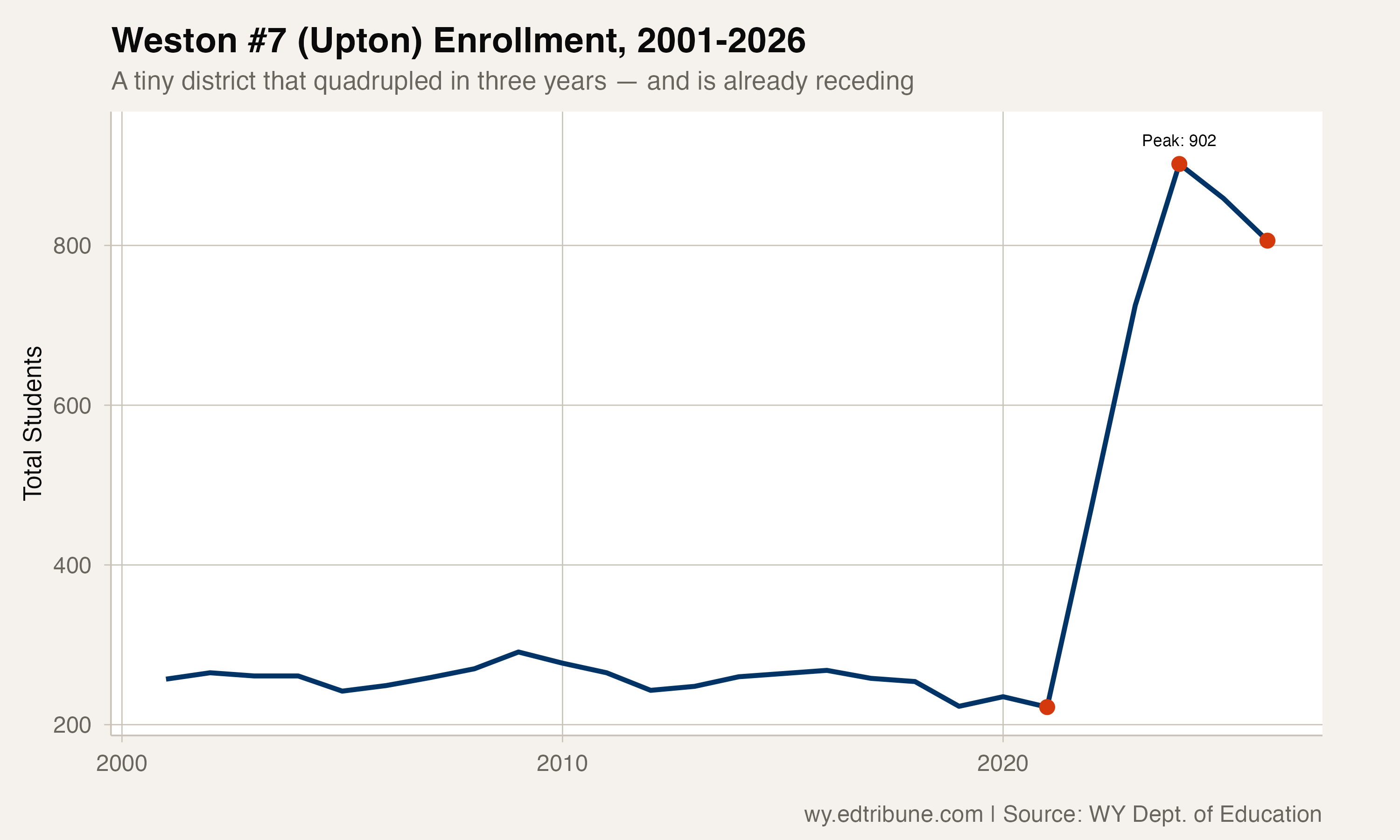
Weston County School District #7↗ET enrolled 222 students in 2021. Three years later, it had 902. A tiny rural district in northeastern Wyoming had quadrupled.
The cause was straightforward: oil activity in the Powder River Basin brought extraction workers and their families to Upton, a town of roughly 1,000 people. The district's elementary school, which held 96 students in 2021, swelled to 601 by 2024. A middle school that had 55 students suddenly had 225.
By 2026, the enrollment is 806. The boom peaked. The decline has begun.
What quadrupling looks like on the ground
Upton Elementary went from 96 to 601 students — an increase that would strain any school, let alone one in a town with a single traffic light. By 2026, it has settled back to 521, still five times its pre-boom size.
Upton Middle School grew from 55 to 225, then eased to 196. Upton High School, interestingly, saw modest growth — from 71 to 89 — suggesting the incoming families had younger children.
The district went from one of Wyoming's smallest to larger than many county seats. In a state where 15 districts enroll fewer than 500 students, going from 222 to 902 in three years creates challenges that have nothing to do with money: finding teachers, finding classrooms, finding housing for the families arriving faster than the town can absorb them.
The boom is already receding
In 2025, the district lost 43 students. In 2026, it lost another 53. The Powder River Basin oil activity that fueled the boom has not ended entirely, but the pace of new extraction has slowed.
This is Wyoming's energy cycle compressed into fast-forward. The state spent a decade — 2006 to 2016 — adding students during the broader energy boom, then another decade giving them back. Upton did the same thing in five years.
The question for Weston #7 is how far the enrollment falls before it stabilizes. At 806 students, the district is still more than three times its pre-boom size. If it returns to something close to its historical level of 220-270, the schools built or expanded for the boom will face the same empty-building problem that every other Wyoming district confronts.
An exception that proves the rule
In a state where only 6 of 48 comparable districts have recovered from COVID and 41 of 51 lost students in 2026, Weston #7↗ET's quadrupling stands out as the most dramatic outlier in the data.
But it is an outlier born of a single industry. The families that arrived in Upton came for oil jobs, the same way families arrived in Gillette for coal and in Rock Springs for gas. The extraction economy creates enrollment booms that are intense, localized, and temporary. When the wells slow, the families leave.
Upton's boom-bust, playing out at the school level in real time, is a compressed version of the story that has defined Wyoming enrollment for two decades. The state grew when energy employment grew. It shrank when energy employment shrank. A single district doing it in three years instead of ten doesn't change the mechanism — it just makes it impossible to ignore.
Detailed code that reproduces the analysis and figures in this article is available exclusively to EdTribune subscribers.
Discussion
Sign in to join the discussion.
Loading comments...