Wyoming reopened its schools faster than almost any state in the country. Yet five years after the pandemic, only 6 of 48 comparable districts have returned to their pre-COVID enrollment levels.
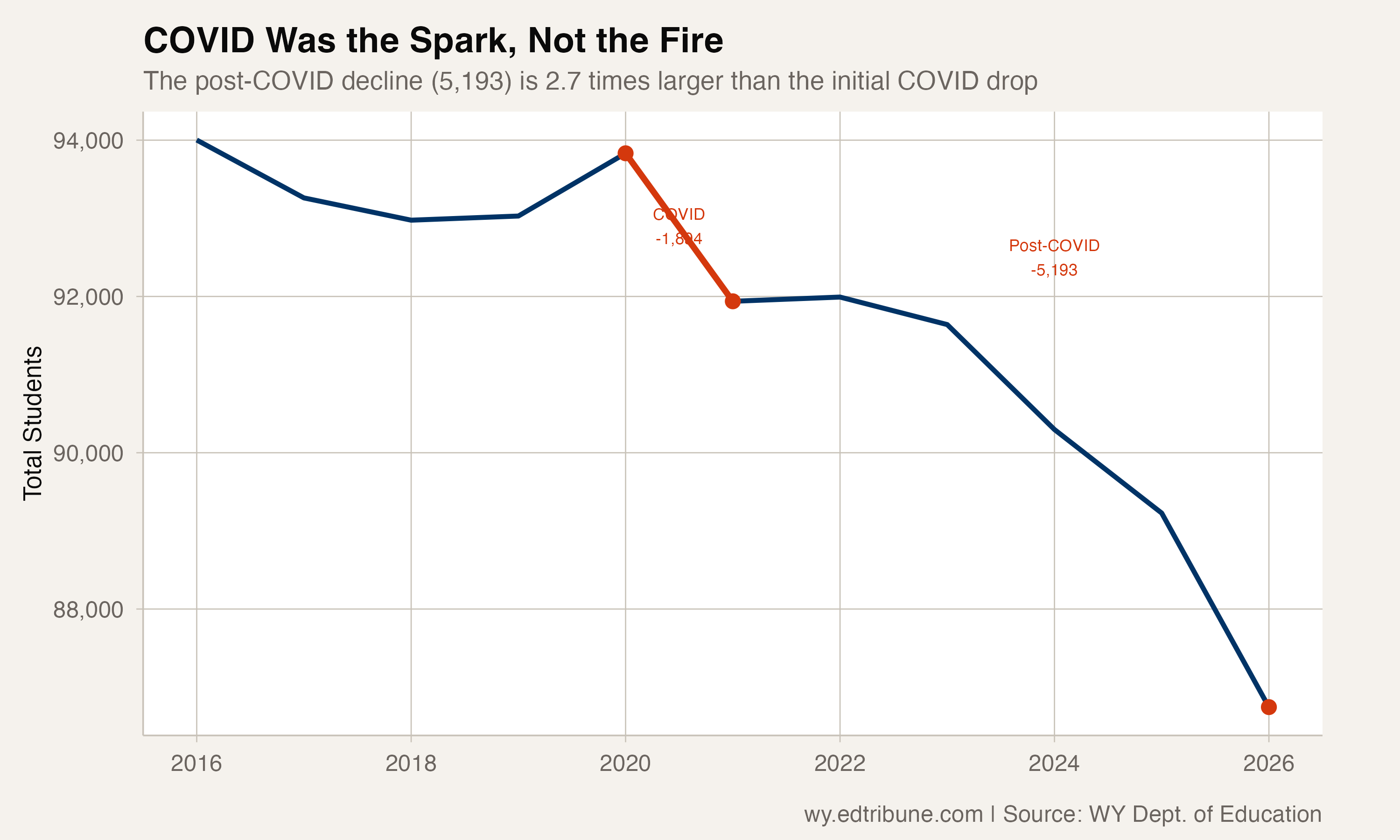
The state lost 1,894 students in the initial COVID year of 2020-21. In the five years since, it has lost an additional 5,193, a post-pandemic decline 2.7 times larger than the pandemic itself.
Wyoming's 12.5 percent COVID recovery rate is among the lowest in the nation. The early reopening did not produce an enrollment rebound. What it produced was a brief stabilization before the structural decline resumed.
The six that came back
The districts that have recovered share a common trait: something happened to them that had nothing to do with demographics.
Weston #7↗ET (Upton) quadrupled from 235 to 806 students between 2020 and 2026, driven by a Powder River Basin oil boom. Big Horn #1↗ET and Niobrara #1↗ET both had anomalous 2021 spikes likely tied to virtual enrollment artifacts, and their "recovery" is partly a return to trend. Sheridan #1↗ET grew on a diversified economy of healthcare, tourism, and ranching. Lincoln #1 and Fremont #2 are small districts with modest but real gains.
None of the six largest districts in Wyoming have recovered. Not one.
The forty-two that didn't
Natrona #1↗ET (Casper) has lost 1,736 students since 2020 — 13 percent of its enrollment. Laramie #1↗ET (Cheyenne) has lost 1,402, nearly 10 percent. Sweetwater #1↗ET (Rock Springs) is down 998, an 18.2 percent decline from a district already battered by the energy bust.
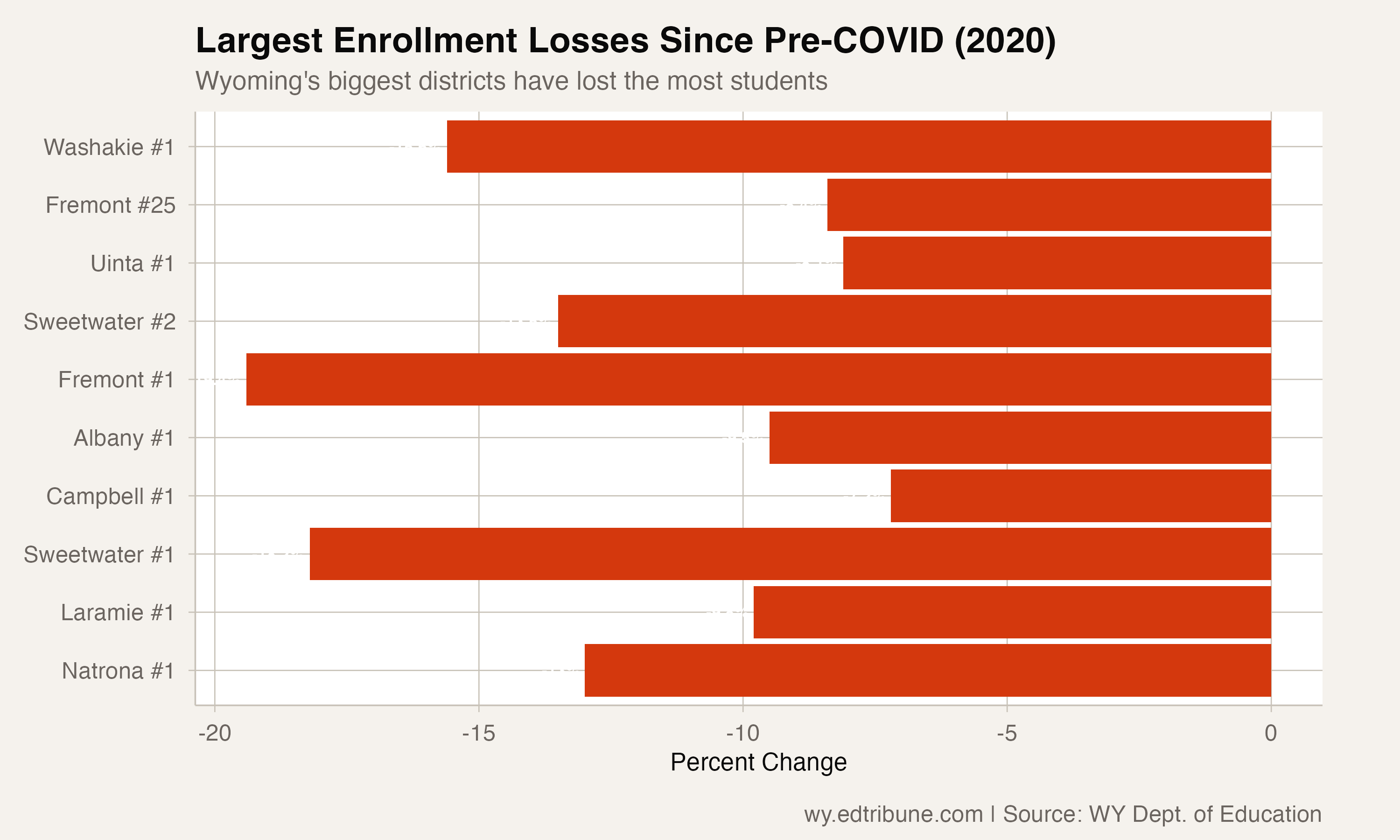
Campbell #1↗ET (Gillette) has lost 632 students. Albany #1 (Laramie, home of the University of Wyoming) lost 383. Fremont #1 (Lander) lost 357, nearly a fifth of its 2020 enrollment.
Among the 42 non-recovered districts, the combined loss is 8,918 students since 2020. The six recovered districts gained a combined 1,152, of which 571 came from the single anomalous case of Upton's oil boom.
COVID didn't cause this
The standard narrative for enrollment loss nationwide centers on the pandemic: families left public schools, went private, went virtual, homeschooled. Some of that happened in Wyoming. But the state's data tells a more complicated story.
Wyoming's enrollment peaked in 2016, not 2020. The state was already losing students before the pandemic: 741 in 2017, 285 in 2018. A brief uptick of 803 in 2020, possibly from families returning to Wyoming's early-reopening classrooms, temporarily masked the underlying trend.
Then COVID hit, and the decline accelerated. But the post-COVID trajectory is not a pandemic aftershock. It is the continuation of a structural contraction that began when energy sector employment peaked.
The University of Wyoming's economic forecast projects the state's school-age population declining through 2031. Every age group under 44 is expected to shrink. The districts waiting for a COVID recovery are waiting for something that demographic forces will not deliver.
What recovery means in Wyoming
In most states, COVID recovery is measured by whether enrollment returned to its 2019 or 2020 baseline. In Wyoming, that question is almost beside the point.
Even if all 48 districts recovered to their 2020 levels tomorrow, the state would still be at 93,832, below its 2016 peak of 94,002 and on a demographic trajectory that continues to point downward. COVID did not create Wyoming's enrollment problem. It revealed it.
Detailed code that reproduces the analysis and figures in this article is available exclusively to EdTribune subscribers.
Discussion
Sign in to join the discussion.
Loading comments...