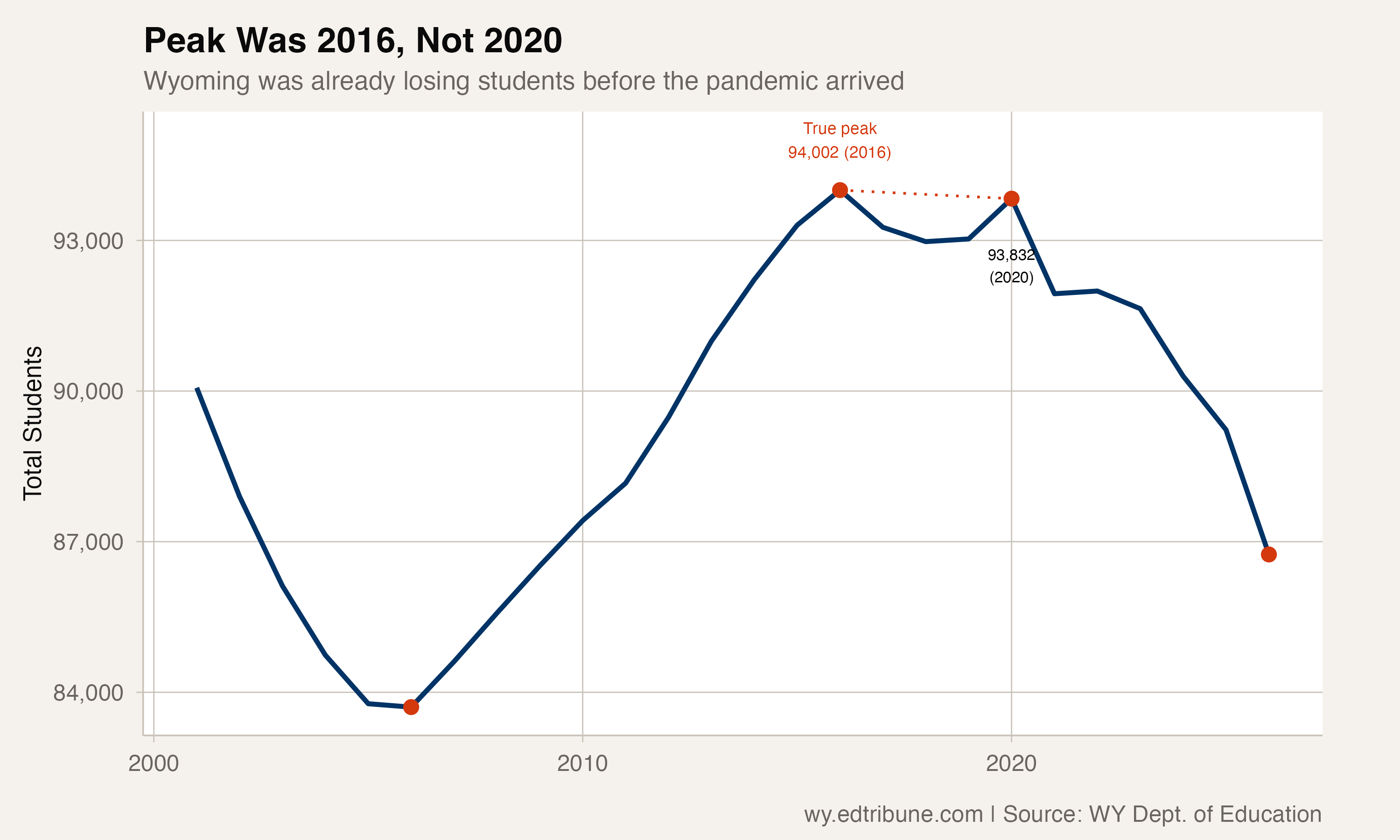
Wyoming's enrollment peaked at 94,002 in 2016. Not 2020.
The distinction matters because it reframes the state's enrollment crisis. If the peak was 2020, the story is about pandemic disruption: schools closed, families left, and some never came back. If the peak was 2016, the story is about structural economic decline that was already underway when COVID arrived.
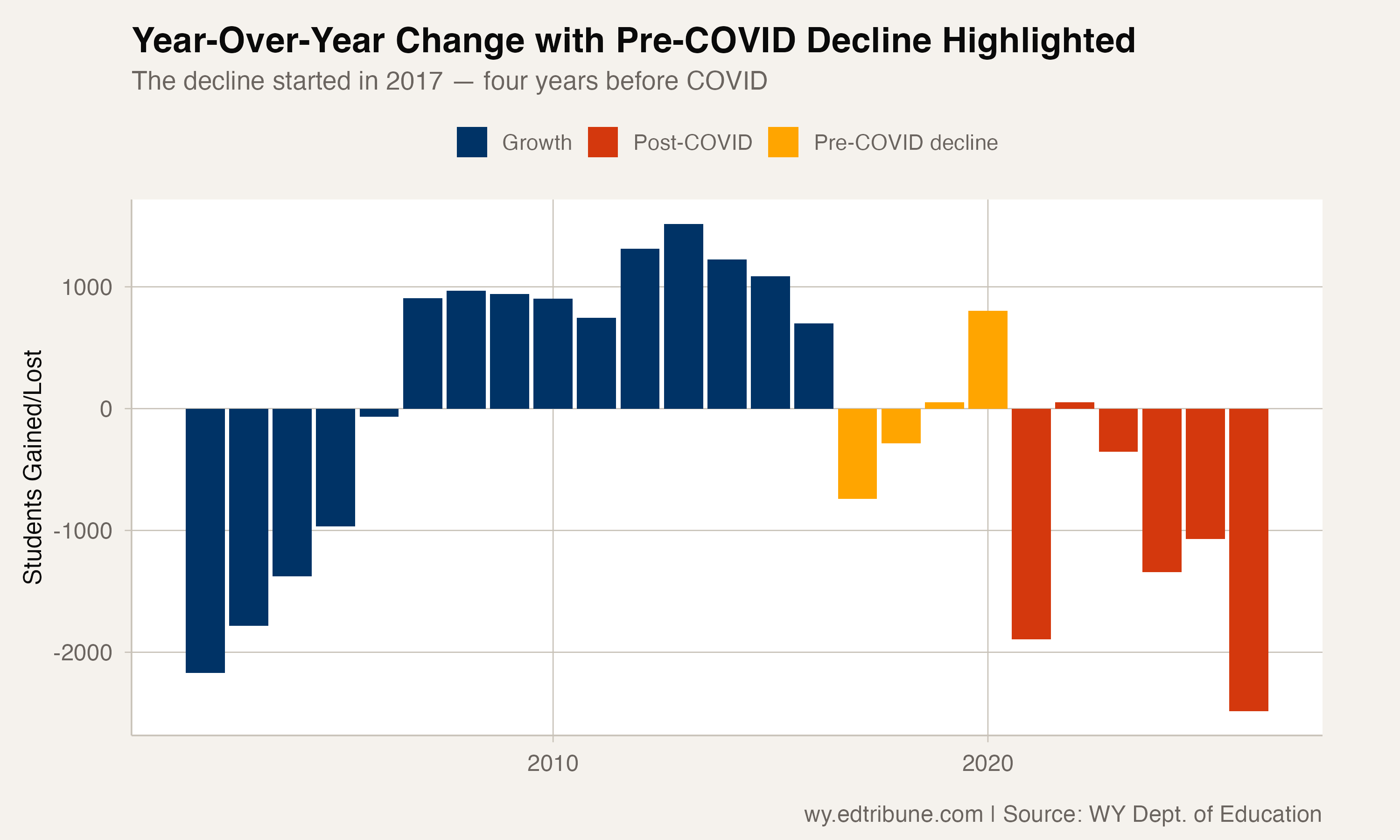
The data is unambiguous. Wyoming reached 94,002 in the 2015-16 school year, then began falling: 741 students lost in 2017, 285 in 2018. A small gain of 53 in 2019 and a larger one of 803 in 2020 briefly interrupted the decline but never returned the state to its 2016 level. The 2020 enrollment of 93,832 was still 170 below the peak.
The energy boom drove the peak
The decade of growth from 2006 to 2016 was almost entirely an energy story. Coal, natural gas, and oil extraction brought workers and families to communities across the state. Enrollment grew every year for ten consecutive years, adding 10,297 students.
That growth ended when energy prices fell. Coal production began its structural decline. Natural gas competition from other basins reduced Wyoming's market position. The families that had come for extraction jobs started leaving, and the schools started shrinking.
The pre-COVID years of 2017 and 2018 looked like a gentle easing, with losses under 1,000 per year. In retrospect, they were the early phase of a decline that would accelerate dramatically.
Why the 2020 uptick doesn't change the story
Wyoming was among the first states to reopen its schools after the initial COVID closures. The 2020 enrollment of 93,832, an 803-student gain, may reflect families moving to Wyoming for open classrooms, or it may be normal statistical fluctuation.
Either way, 93,832 was still below the 2016 peak of 94,002. The "recovery" never actually recovered anything. And once the pandemic's disruption passed, the underlying trend reasserted itself with force: 1,894 lost in 2021, 352 in 2023, 1,343 in 2024, 1,069 in 2025, and 2,483 in 2026.
No reversal in sight
Birth rates in Wyoming began falling before 2016. Out-migration accelerated with the energy bust. Housing costs in the state's few growing communities discourage young families from settling. Every demographic current that could refill classrooms is flowing in the wrong direction.
The 2016 peak was not an anomaly. It was the high-water mark of an energy-driven growth cycle that has now reversed. Wyoming gained 10,297 students during the boom and has given back 7,257, with no demographic tailwind to reverse the trend.
Calling this a COVID problem is easier than confronting a structural contraction tied to the state's economic model. But the data says the decline started four years before any school closed for a pandemic.
Detailed code that reproduces the analysis and figures in this article is available exclusively to EdTribune subscribers.
Discussion
Sign in to join the discussion.
Loading comments...