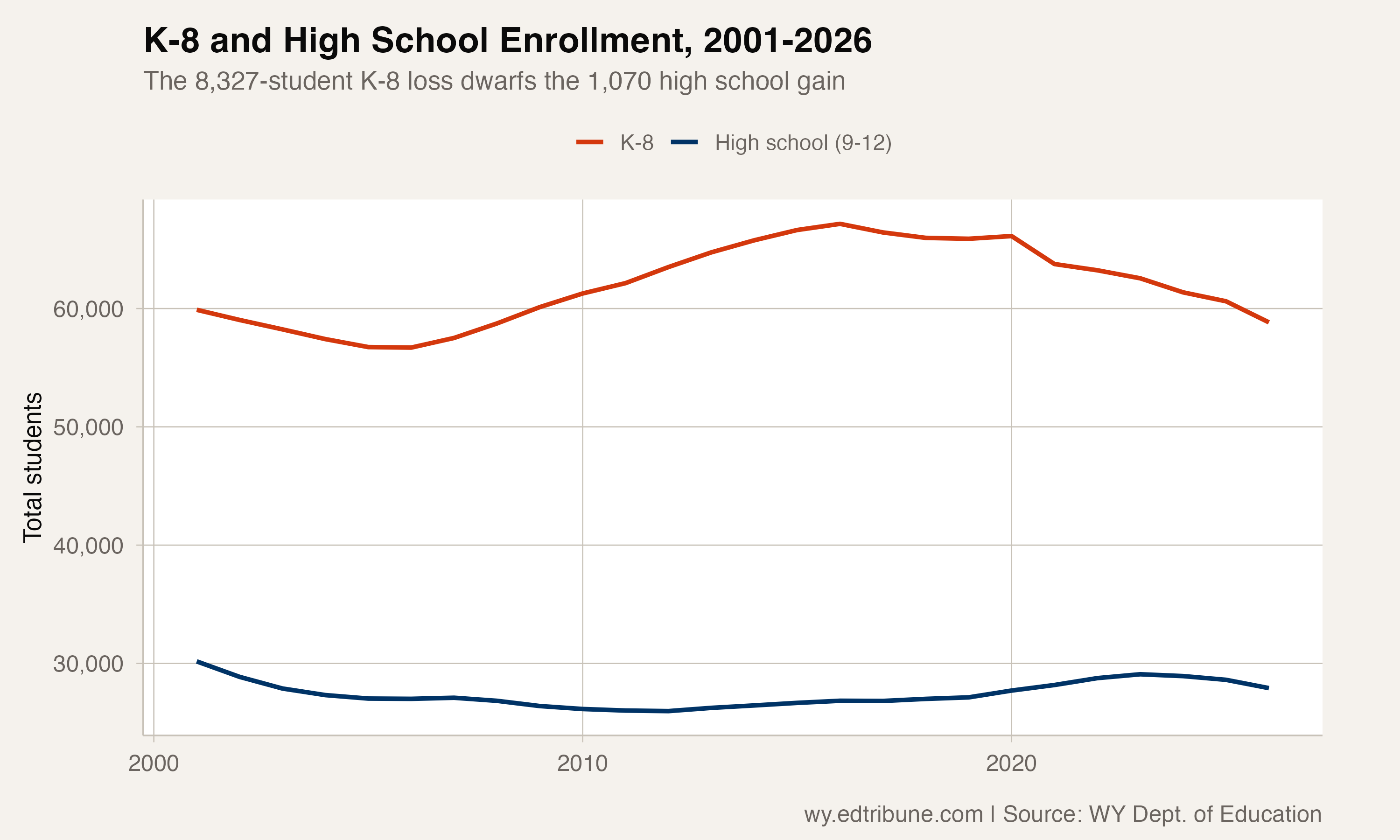
Wyoming's enrollment decline is not hitting all grades equally. The K-8 grades have lost 8,327 students since the 2016 peak — a 12.4 percent drop. High school grades 9 through 12 actually grew by 1,070 students over the same period, up 4 percent.
The divergence creates a deceptive impression. High school principals see stable or growing numbers. Elementary principals see empty classrooms. Both are looking at the same underlying trend from different points in the pipeline.
Why the bottom is collapsing
The K-8 decline tracks directly to falling kindergarten enrollment. Wyoming's kindergarten peaked at 8,141 in 2014 and has since fallen to 6,064 — a 25.5 percent drop. Those smaller classes have been moving through the grades for a decade, leaving each elementary and middle school grade thinner than the one that preceded it.
In 2016, K-8 served 67,159 students. By 2026, it serves 58,832. That is 8,327 fewer students in the grades where Wyoming operates the most schools, employs the most teachers, and maintains the most buildings.
The decline rate of 12.4 percent is about 1.6 times the overall state enrollment decline of 7.7 percent since 2016. The lower grades are absorbing a disproportionate share of the contraction.
Why the top is holding
High school enrollment has been temporarily insulated by the large cohorts that entered kindergarten during the energy boom years of 2008 through 2015. Those classes ranged from 6,891 to 8,141 kindergartners. The tail end of that run is still inflating the upper grades even as the lower grades shrink.
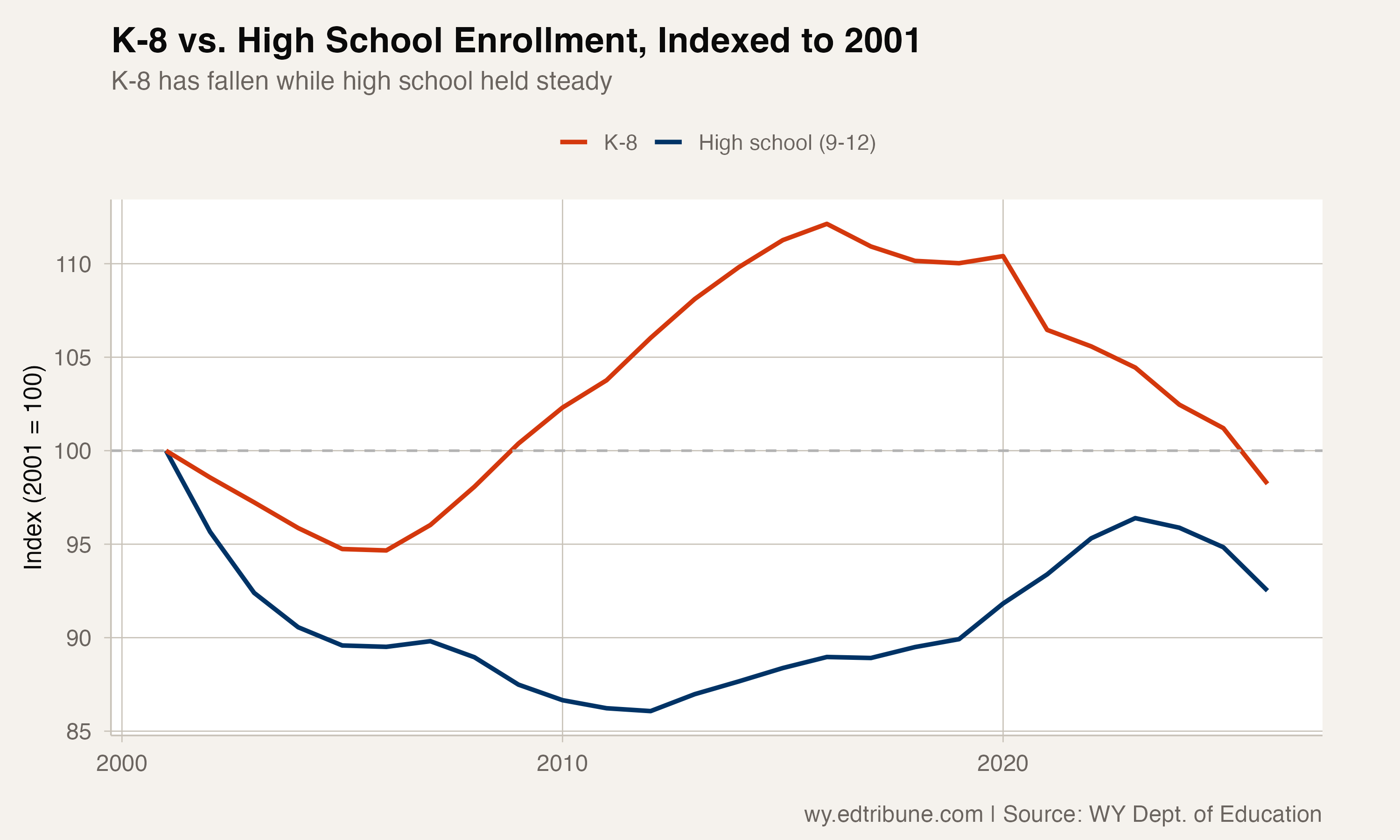
Grade 12 reached an all-time high of 6,898 in 2025. High school enrollment hit a post-2007 high of 29,084 in 2023, though it remained below the 2001 peak of 30,172, and has already begun declining — down to 27,913 in 2026. The boom-era cohorts are graduating, and the smaller classes behind them are starting to arrive.
This is the leading edge of a second wave of decline that will hit Wyoming's high schools between 2030 and 2035.
The two-wave future
Wyoming's enrollment contraction is playing out in waves, determined by the grade-by-grade flow of students through the system.
The first wave hit K-8 starting around 2016-2017, as smaller post-boom kindergarten classes reduced the number of students in each elementary grade. This wave is well underway, with K-8 losing students every year since 2017.
The second wave will hit high schools around 2030-2032, as smaller kindergarten classes from the early 2020s reach ninth grade. When they do, high school enrollment will drop sharply, and the total state enrollment decline will accelerate.
The temporary resilience of high school enrollment has provided a buffer. High schools have maintained staffing levels, kept programs funded, and avoided the consolidation pressures that elementary schools are already facing. That buffer is eroding. By 2035, the kindergarten class of 2022 — 7,060 students — will be seniors, and the high school enrollment that looked stable in 2023 will look like the K-8 numbers do now.
Wyoming's school system is not declining uniformly. It is draining from the bottom up, with a delay of roughly 13 years between what kindergarten enrollment signals and what high school graduation confirms. The K-8 collapse is the preview. High school's decline is the same story, just arriving later.
Detailed code that reproduces the analysis and figures in this article is available exclusively to EdTribune subscribers.
Discussion
Sign in to join the discussion.
Loading comments...