Laramie County School District #1↗ET is planning to close eight elementary schools in phases through 2035 — the most dramatic consolidation in Wyoming's history.
Parents sued the state in December 2024 to halt the plan. A March 2025 court ruling that Wyoming has unconstitutionally underfunded its K-12 schools has strengthened their argument. But the enrollment data explains why the district sees no alternative.
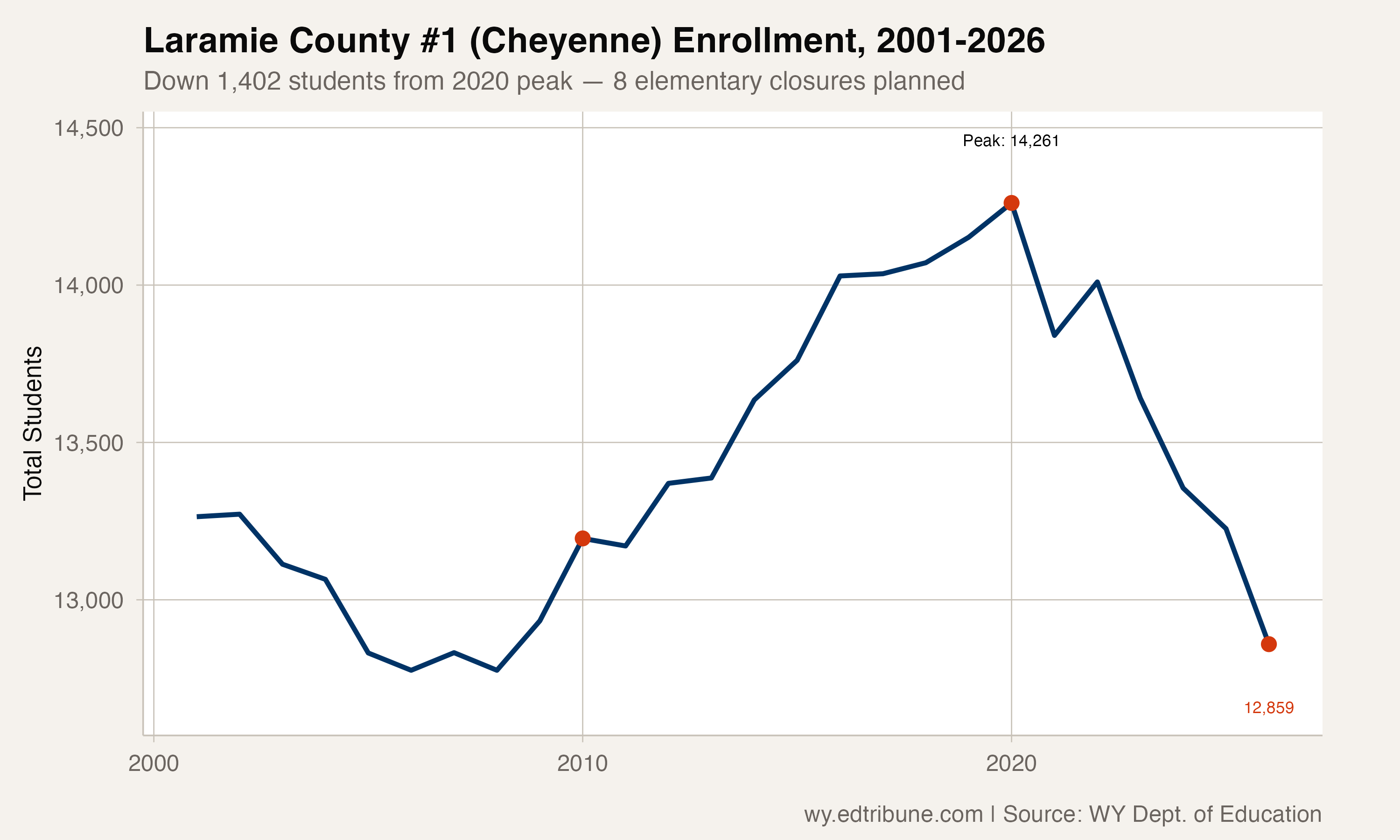
Cheyenne's enrollment peaked at 14,261 in 2020. Six years later, it stands at 12,859 — a loss of 1,402 students, nearly 10 percent. Wyoming's largest district, serving 14.8 percent of the state's students, has buildings designed for enrollment levels it no longer has.
Empty classrooms across the district
The losses are concentrated in the elementary schools — exactly where Cheyenne's closure plan is focused. Laramie County School District 1 says the state-backed remedy would build four new elementary schools while closing eight smaller, aging schools over the next decade.
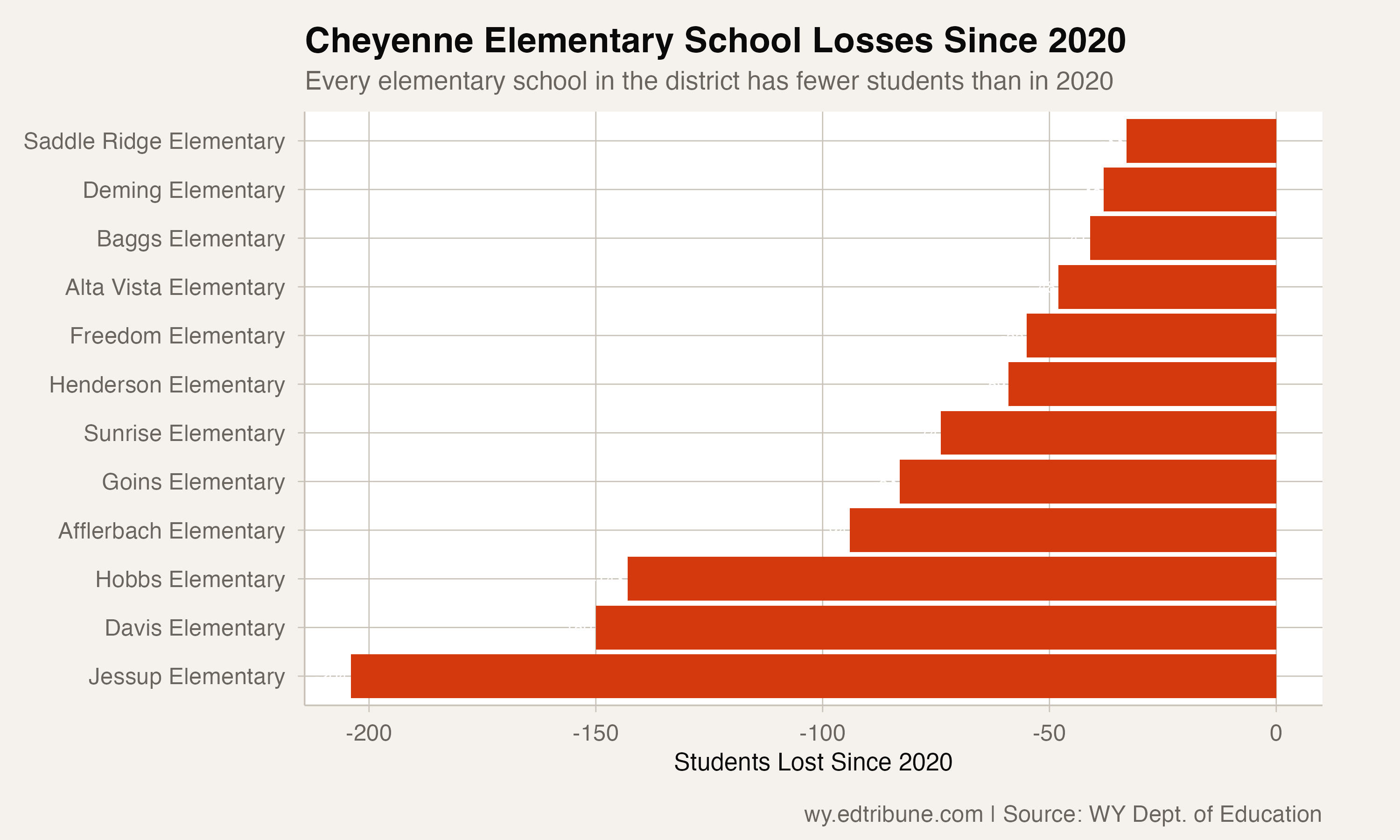
Jessup Elementary has lost 204 students since 2020, dropping from 303 to 99. Davis Elementary fell from 363 to 213. Hobbs Elementary went from 373 to 230. Afflerbach, Goins, Sunrise, Henderson, Freedom — the pattern repeats across the district's elementary schools. Of the 28 elementary campuses with data in both years, 23 enrolled fewer students in 2025-26 than in 2020.
Some buildings tell a longer story. Hobbs Elementary has gone from 451 students in 2016 to 230 in 2026 — nearly half its enrollment gone in a decade. Dildine Elementary dropped from 493 to 279. Buffalo Ridge fell from 294 to 161. These are not minor fluctuations. They are structural declines in buildings that were full ten years ago.
The high schools, by contrast, are holding steady. East High gained 101 students since 2020. Central High added 58. The large cohorts from the boom era are flowing through the upper grades while the pipeline below is contracting.
The kindergarten signal
Cheyenne's kindergarten enrollment peaked at 1,186 in 2014 and has fallen to 904 in 2026 — a 24 percent decline. The district is enrolling 282 fewer kindergartners each year than it was a decade ago.
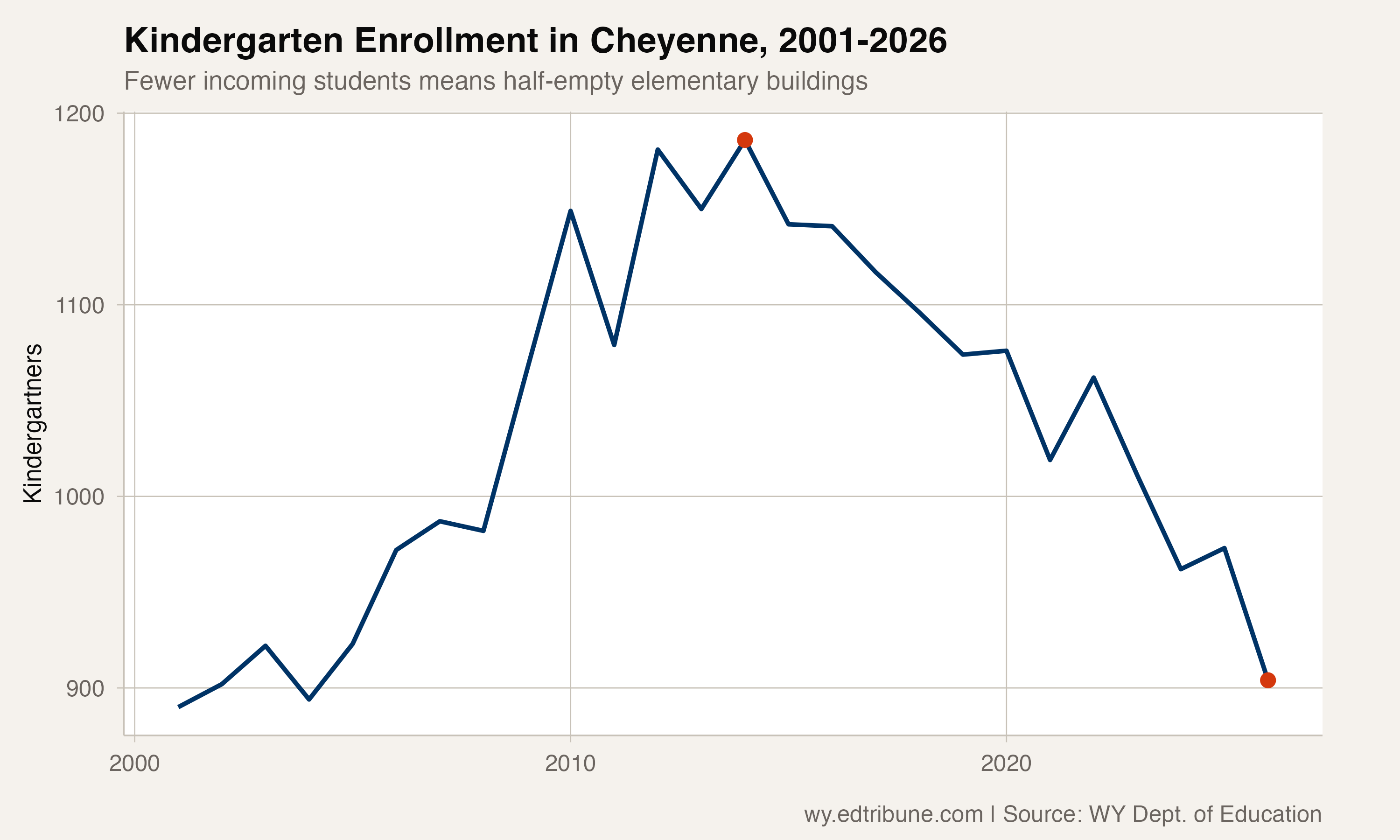
Those smaller kindergarten classes will continue moving through the system, leaving each grade with fewer students than the one before. Elementary buildings designed for 300-400 students are now serving 150-250. The math leads inevitably toward consolidation.
The lawsuit and the funding gap
The closure plan has become entangled with a broader fight over school funding. Wyoming's School Foundation Program allocates money based on student headcount, creating a direct link between enrollment decline and budget cuts. The district has lost the funding equivalent of 1,402 students while maintaining buildings, staff, and infrastructure sized for a larger enrollment.
The March 2025 court ruling found that the legislature has unconstitutionally underfunded K-12 education. The same month, legislators cut $17.5 million from the recommended $66.3 million cost adjustment. Parents opposing the closures argue that the state should fund the schools rather than close them.
The district's position is that the buildings need students, not just dollars. A school serving 99 students in a building designed for 300 is inefficient regardless of the funding formula. With kindergarten enrollment falling and no demographic reversal in sight, Cheyenne faces a decade of continued contraction.
Eight elementary closures through 2035 would reshape the district that serves nearly one in six Wyoming students. Whether those closures happen through the district's plan, through the courts, or through the slow attrition of enrollment, the buildings will eventually find a smaller system.
Detailed code that reproduces the analysis and figures in this article is available exclusively to EdTribune subscribers.
Discussion
Sign in to join the discussion.
Loading comments...