Part of the Wyoming Graduation Rate series.
The package's most recent published graduation results are for 2025, representing the 2024-25 school year. They are historical results, not current 2026-27 outcomes.
In 2024-25, Wyoming students who concentrated in Career and Technical Education programs had a 94.9% four-year graduation rate, nearly 12 percentage points above the 83.1% all-student rate. The premium appeared in all five published years of CTE data, ranging from 11.8 to 14.7 points.
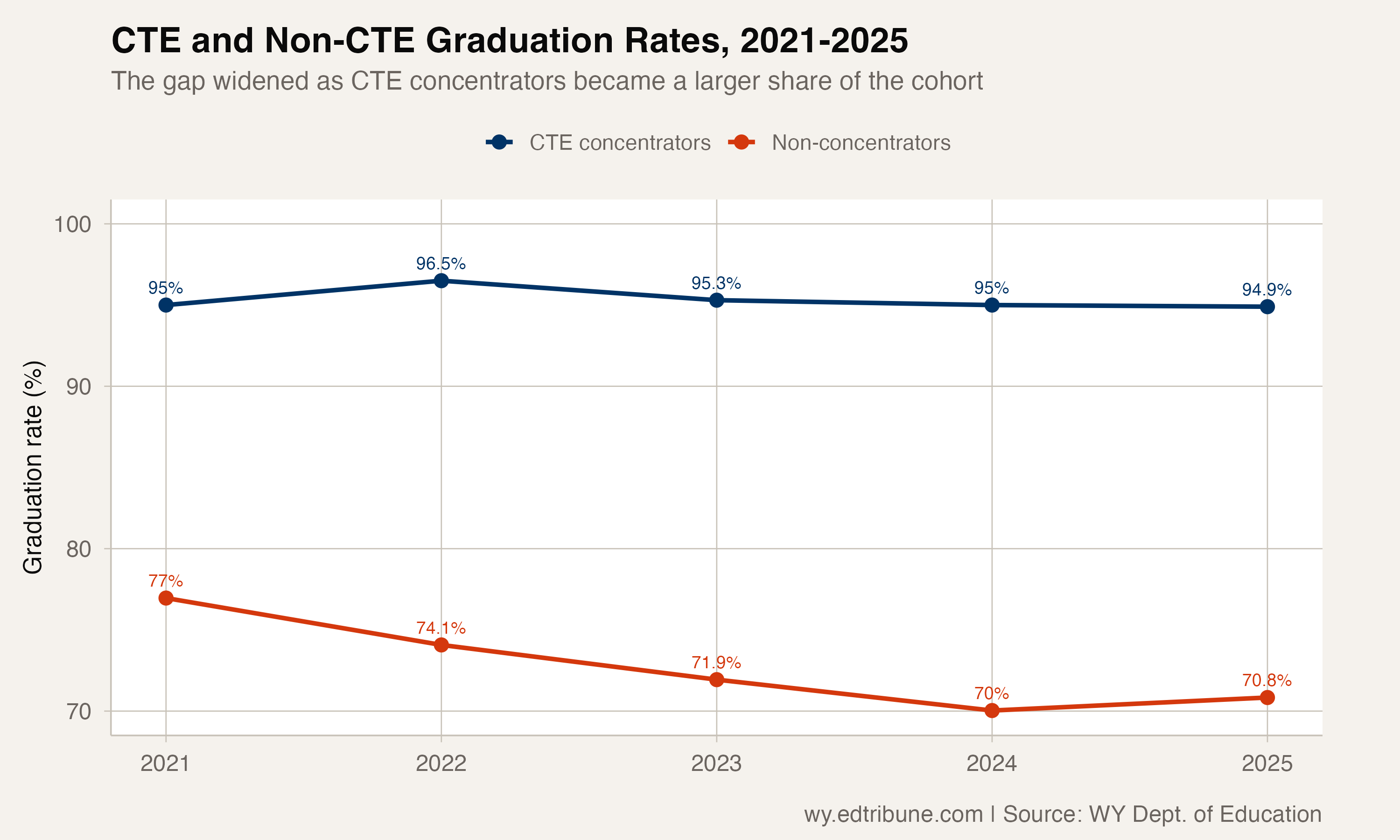
But the state data does not show that the CTE programs caused the premium. It shows that the composition of the comparison changed: CTE concentrators grew from 30.5% of the published 2021 cohort to 51.1% in 2025. Over the same span, the non-concentrator rate fell from 77.0% to 70.8%, and the gap between CTE and non-CTE students widened from 18.0 to 24.1 points.
The published 2025 totals were 7,683 students and 6,385 graduates overall, including 3,925 CTE concentrators and 3,723 CTE graduates. Subtracting the CTE totals from the published all-student totals leaves 3,758 non-concentrators and 2,662 graduates in that complement.
That pattern is consistent with a selection explanation: the students who complete a CTE sequence may differ from those who do not. It is suggestive context, not direct evidence of a program effect. In Fremont #14↗ET (Ethete), a district with a 63.4% overall rate, CTE concentrators graduated at 100% in 2025. In Natrona #1↗ET (Casper), the overall rate was 77.7% and the CTE rate was 95.3%.
The premium at scale
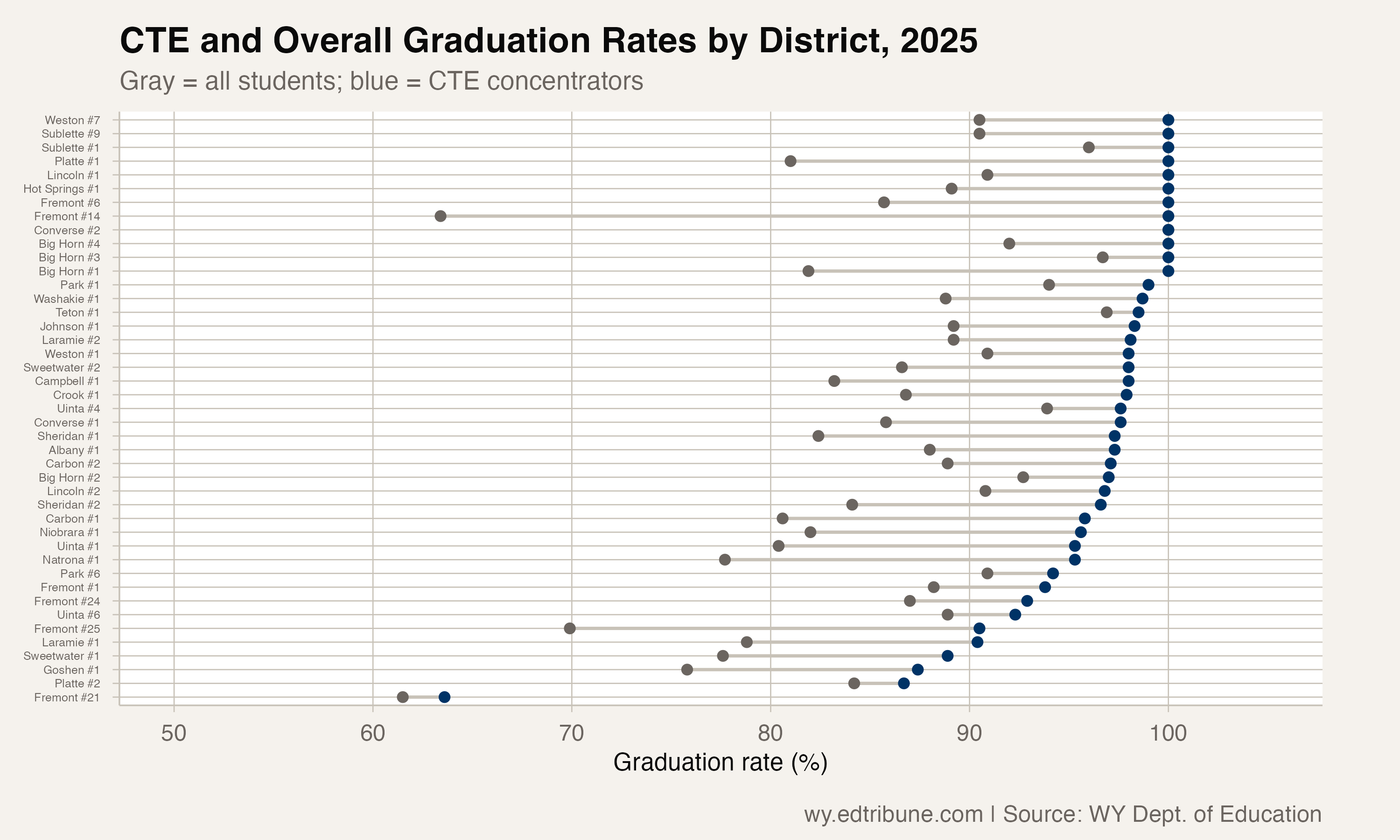
Across 43 Wyoming districts reporting CTE graduation data in 2025, the mean CTE premium was 10 percentage points. Twelve districts saw their CTE concentrators graduate at 100%. The lowest CTE graduation rate among reporting districts was 63.6%.
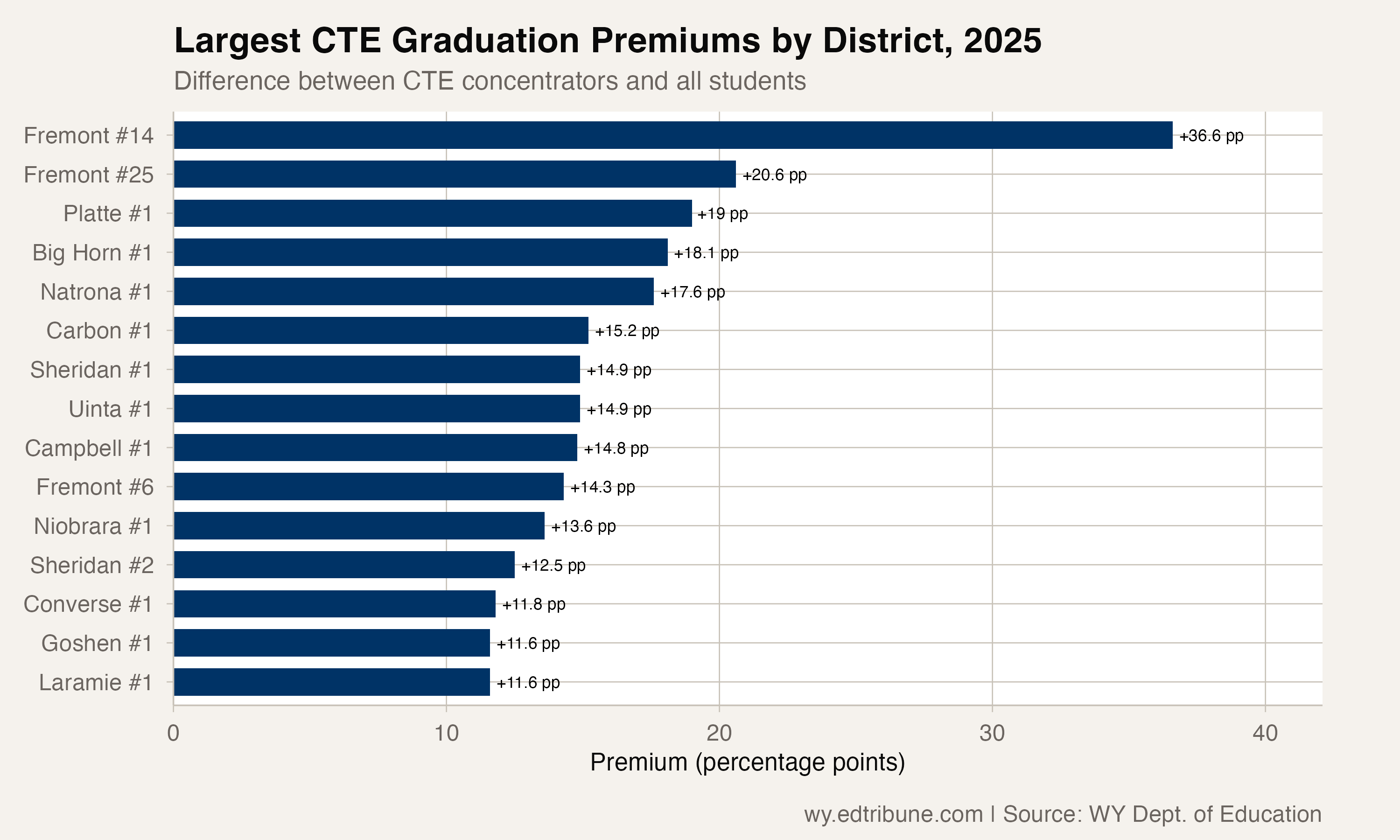
The lowest CTE rate was 63.6% in Fremont #21. The widest premium was in Fremont #14: 36.6 points, from a 63.4% overall rate to a 100% CTE rate. In Fremont #25↗ET (Riverton), the corresponding figures were 69.9% overall and 90.5% for CTE concentrators.
Five years of consistency
The statewide CTE premium was 12.6 points in 2021, 14.7 in 2022, 13.9 in 2023, 13.4 in 2024 and 11.8 in 2025. The 2025 CTE rate, 94.9%, was the lowest of those five years, while the all-student rate reached 83.1%.
The five-year series is not a causal test. It is a description of two published groups whose membership and outcomes changed over time. The clearest finding is the composition shift: CTE concentrators became a majority of the four-year cohort while the non-concentrator rate declined.
What CTE does not explain
The data cannot distinguish whether CTE participation improves graduation, whether students already positioned to graduate are more likely to complete a CTE sequence, or whether both processes are operating. Those are competing explanations. The published rates support the descriptive comparison; they do not isolate a treatment effect.
What is direct evidence is narrower and more useful: in 2025, CTE concentrators graduated at 94.9%, while non-concentrators graduated at 70.8%; CTE concentrators made up 51.1% of the published cohort. The difference is real in the data, but its mechanism remains unresourced here.
Rates and published cohort totals come from the Wyoming Department of Education's graduation-rate reports. Non-concentrator counts and rates are calculated as the published all-student totals minus the published CTE totals; no category rows are summed.
Detailed code that reproduces the analysis and figures in this article is available exclusively to EdTribune subscribers.
Discussion
Sign in to join the discussion.
Loading comments...