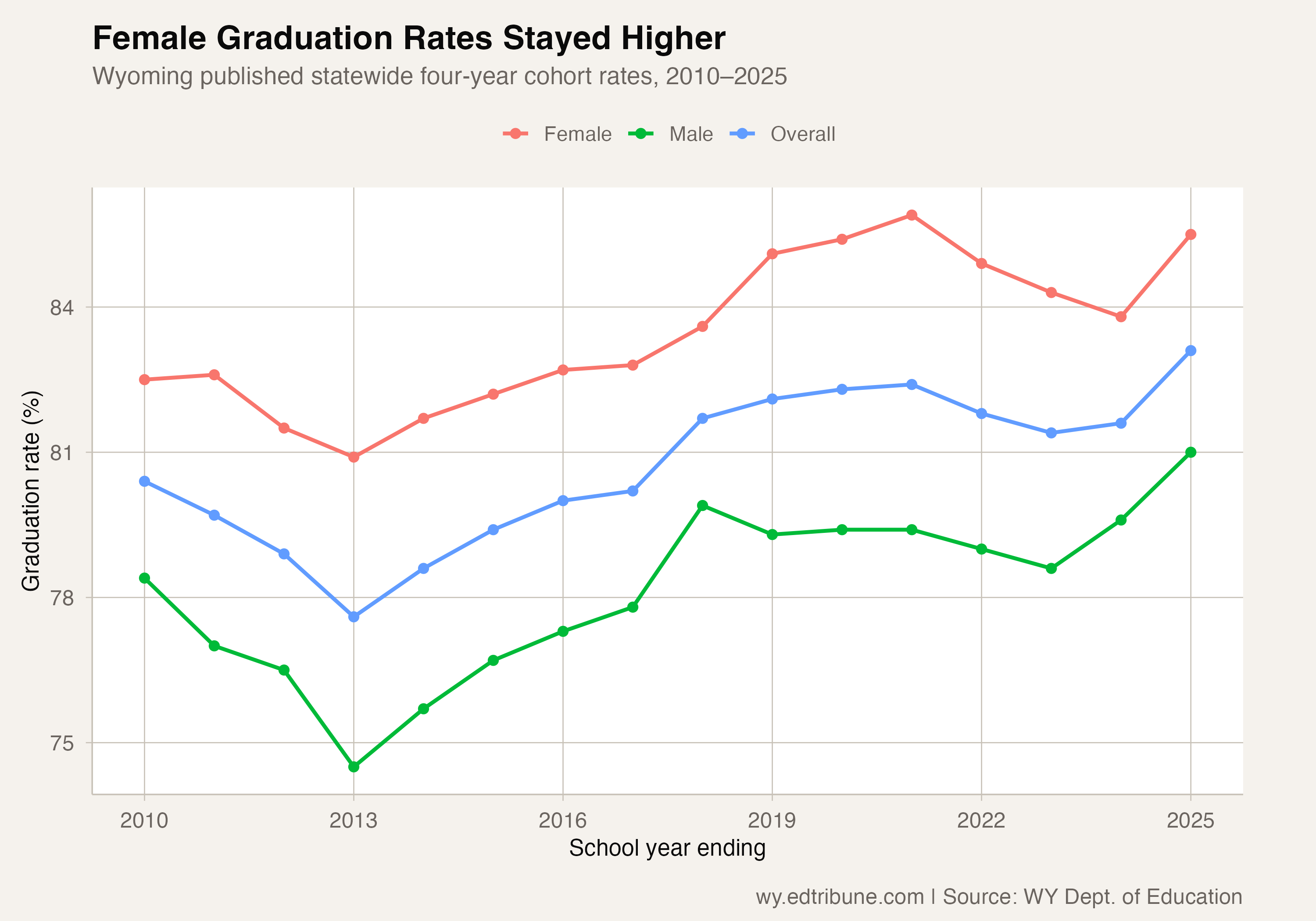
Female students had higher four-year graduation rates than male students in all 16 years of Wyoming's published statewide series, from 2009-10 through 2024-25. The female-male gap ranged from 3.7 to 6.5 percentage points across those observations.
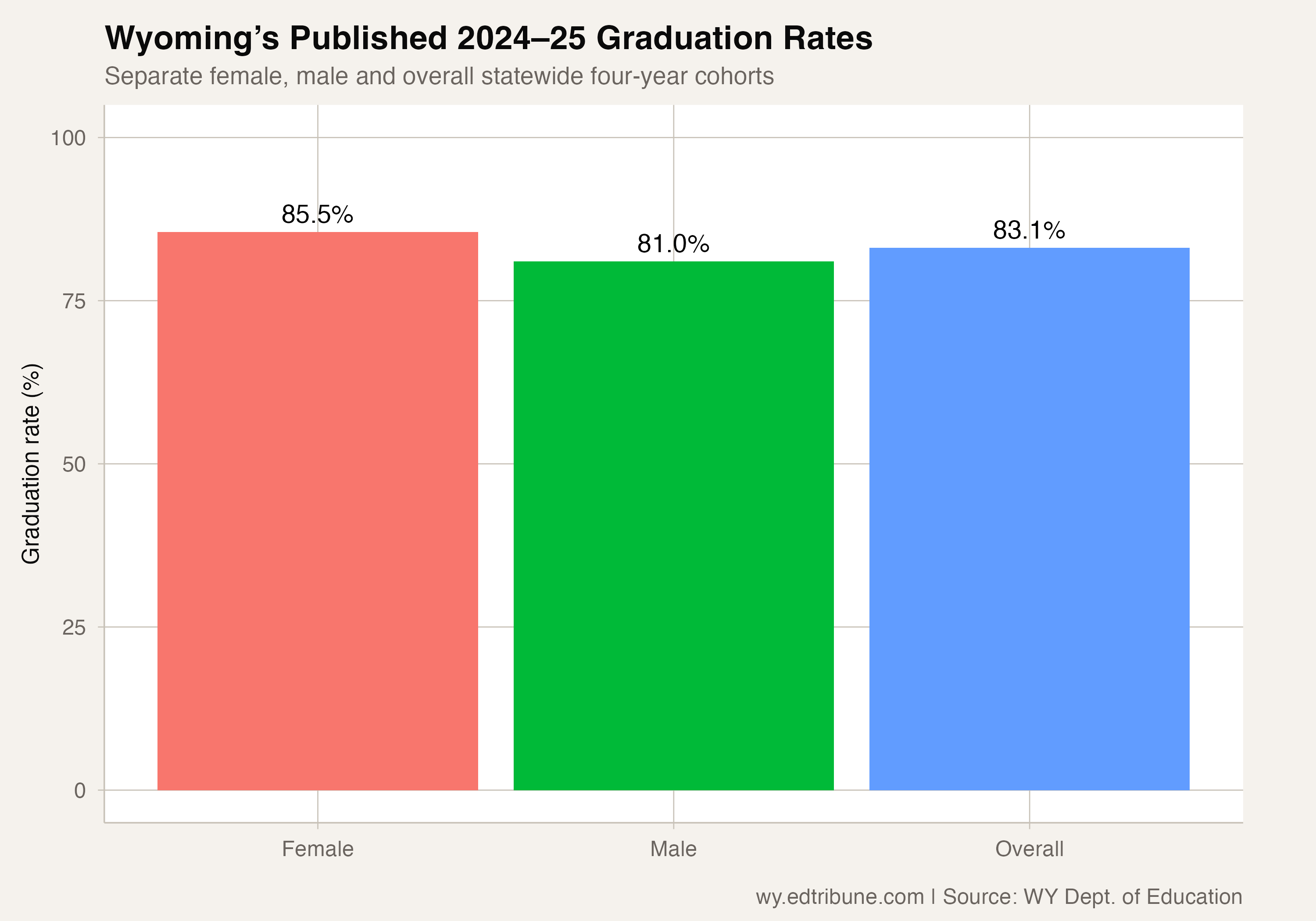
Last school year's published rates were 85.5% for female students and 81.0% for male students, a 4.5-point gap. Wyoming's overall four-year rate was 83.1%. These are completed cohort results for 2024-25, rather than figures for the current school year.
Both endpoint rates rose, but the gap remained
In 2009-10, the female rate was 82.5% and the male rate was 78.4%, a difference of 4.1 points. Through 2024-25, the female rate rose by 3.0 points and the male rate by 2.6 points. The endpoint gap therefore widened by 0.4 points.
That comparison does not describe uninterrupted improvement. Annual rates fluctuated, and each year's cohort represents a different group of students.
The widest gap was in 2020-21: female students graduated at 85.9%, while the male rate was 79.4%, a difference of 6.5 points. The narrowest was in 2017-18, when the female rate was 83.6% and the male rate was 79.9%, a gap of 3.7 points.
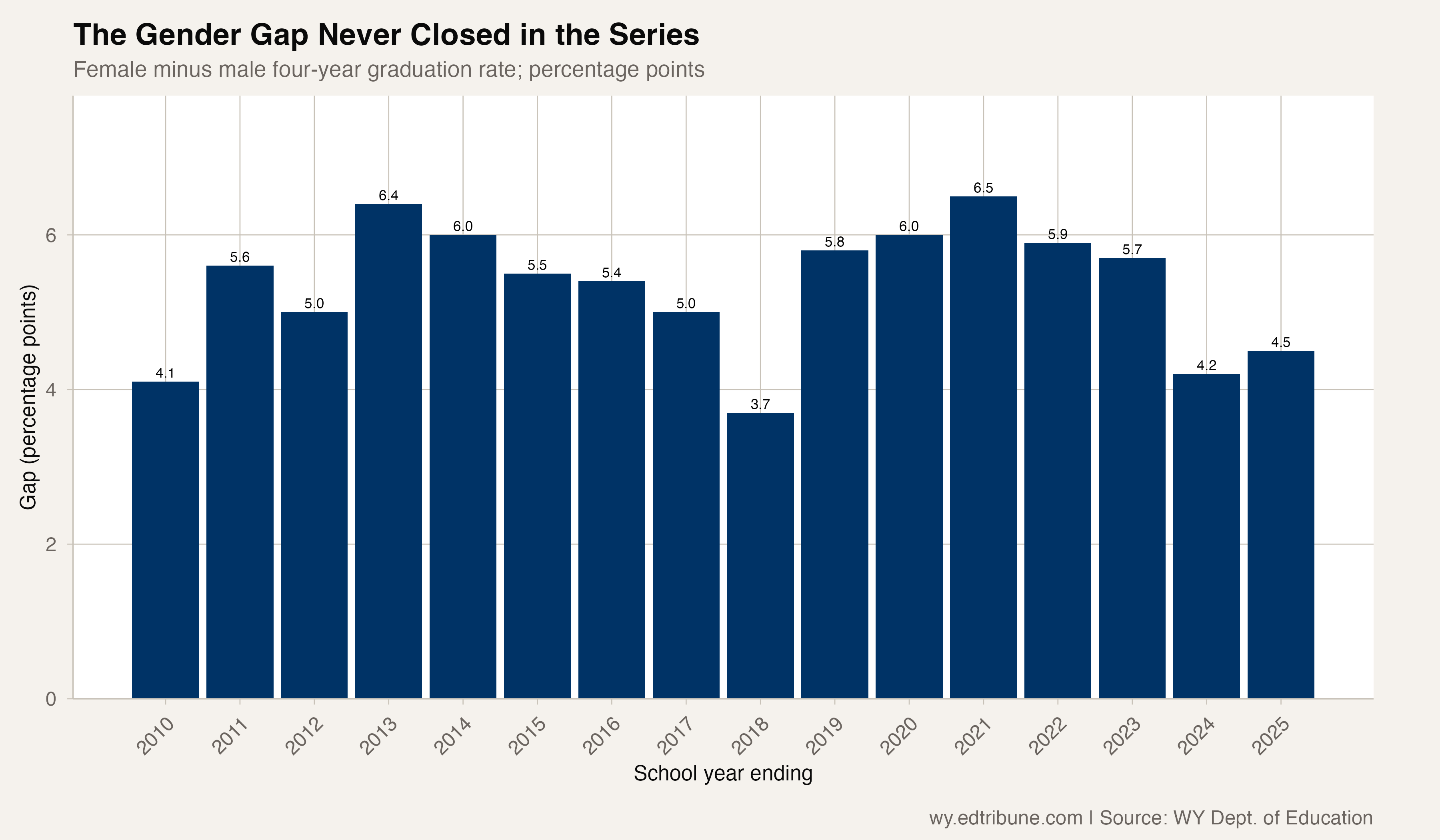
The gap was 4.2 points in 2023-24 and 4.5 points in 2024-25, widening by 0.3 points in the latest year. Its size varied, but its direction did not reverse in any reported year.
The published cohorts were different sizes
The 2024-25 female cohort contained 3,647 students, of whom 3,117 graduated. The male cohort contained 4,036 students, of whom 3,268 graduated. Those counts reconcile with the independently published statewide total: a cohort of 7,683 and 6,385 graduates.
Male students made up 52.5% of the published cohort; female students made up 47.5%. The overall rate therefore cannot be interpreted as a simple average of two equally sized groups.
Higher latest rates did not erase the difference
The male rate of 81.0% was its highest in the full available four-year series. The female rate of 85.5% was below only the 85.9% rate recorded in 2020-21. The overall rate of 83.1% was also its highest in that series.
Those results show that a persistent gender gap can coexist with higher completion rates. They do not explain why the gap exists or establish whether it looks the same within individual districts. The statewide annual cohorts cannot identify a particular barrier, intervention or cause.
Wyoming's latest results improved on the preceding year for both female and male students. The comparison to the start of the series also shows gains for both groups. Yet neither comparison erased the difference in their published graduation rates.
Detailed code that reproduces the analysis and figures in this article is available exclusively to EdTribune subscribers.
Discussion
Sign in to join the discussion.
Loading comments...