Part of the Wyoming Graduation Rate series.
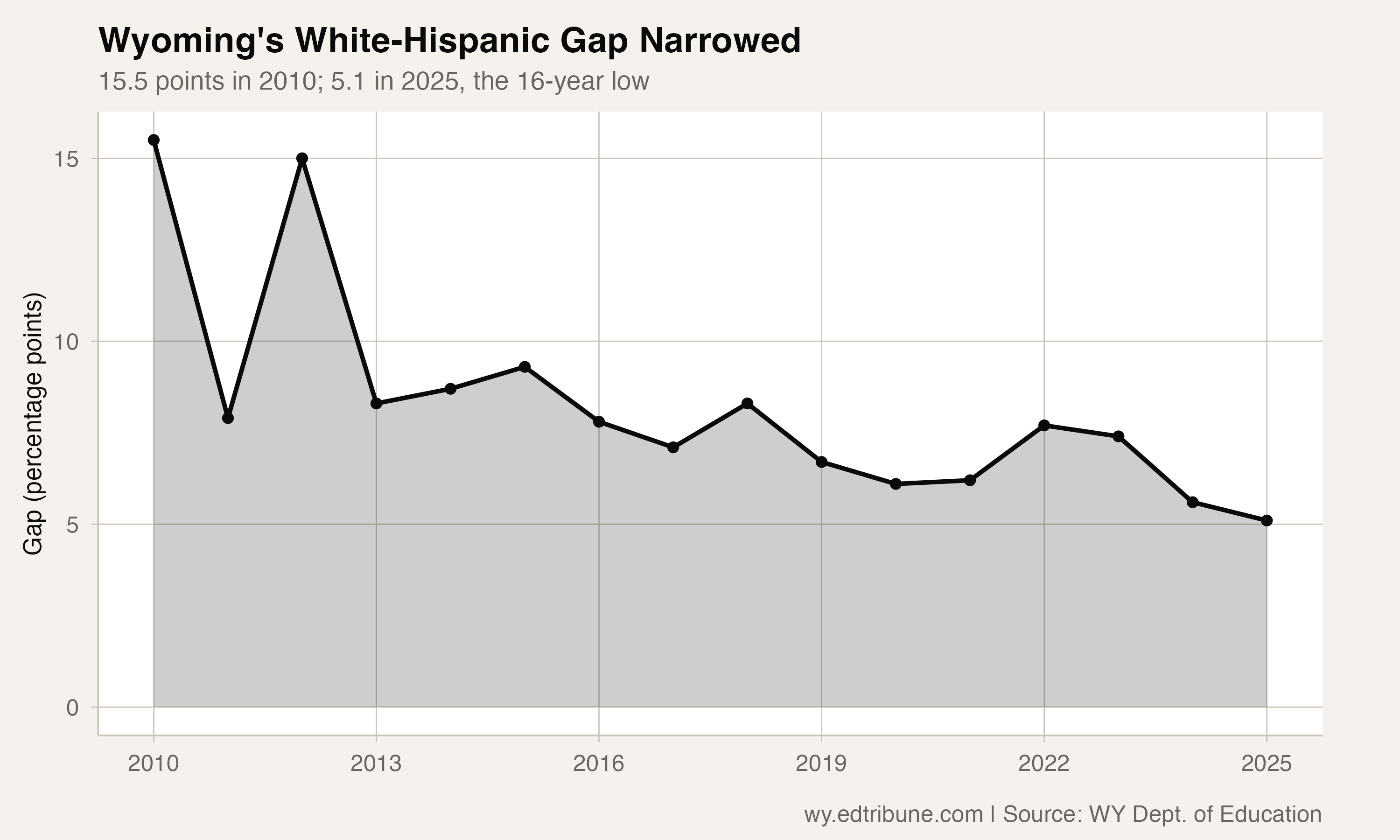
The white-Hispanic graduation rate gap in Wyoming hit 5.1 percentage points in 2024-25, the smallest in the state's 16 years of federal cohort data.
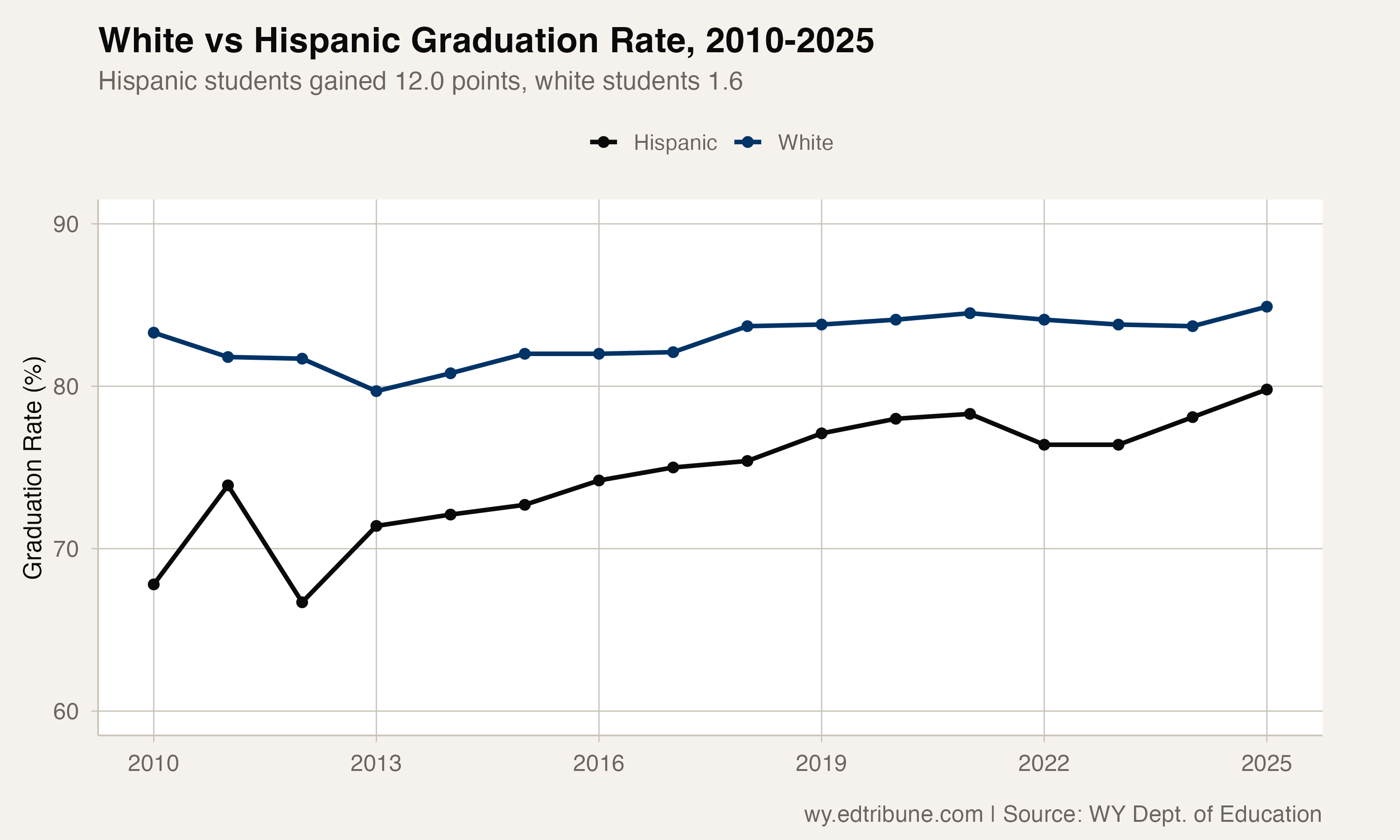
Hispanic students graduated at 79.8%, up 12 points from 67.8% in 2010. White students graduated at 84.9%, up 1.6 points from 83.3%. The gap shrank because Hispanic students improved seven and a half times faster than white students.
Measured against white students, 5.1 points is the narrowest gap of any racial group in the state. Black students trail white students by 5.9 points, students of two or more races by 9.2 points, Native American students by 23.1 points and Pacific Islander students by 24.9 points. Asian students are the only group ahead of white students, at 91.8%, though on a cohort of 61 students.
The closing arc
The gap narrowing has not been perfectly linear. The trajectory shows three phases.
First, a volatile start: 15.5 points in 2010, down to 7.9 in 2011, back up to 15.0 in 2012, down to 8.3 in 2013. The Hispanic cohort numbered between 667 and 780 students in those years, against 1,204 in 2025, small enough that a difference of fifty students moved the rate more than six points.
Second, a closing trend from 2014 through 2020, though not a straight one: the gap fell from 8.7 to 6.1 points but widened in 2015 and again in 2018. The Hispanic rate itself rose in every one of those years, from 72.1% to 78.0%.
Third, a COVID-era reversal and recovery. The gap widened to 7.7 points in 2022 as the Hispanic rate dropped from 78.3% to 76.4% while the white rate slipped only 0.4 points, from 84.5% to 84.1%. The 2025 gap of 5.1 points represents a full recovery and a series low.
The 12-point improvement
Hispanic students' 12-point gain from 67.8% to 79.8% is the second-largest improvement of any racial subgroup, behind Native American students, who gained 16.9 points from a far lower 2010 base of 44.9%. Since 2013 the Hispanic rate has also been the steadier of the two: its largest single-year move in that span is 1.9 points.
The improvement did not come from a shrinking group. Wyoming's Hispanic graduating cohort grew from 667 students in 2010 to 1,204 in 2025, rising from 9.9% to 15.7% of the statewide cohort, and the number of Hispanic graduates more than doubled, from 452 to 961.
At 79.8%, Hispanic students in Wyoming's 2024-25 cohort graduated at a rate close to the overall state average of 83.1%. The remaining gap is 3.3 points to the state average and 5.1 points to white students. A decade ago, in 2015, those two gaps stood at 6.7 and 9.3 points: the distance to the state average has since more than halved, and the distance to white students has closed by nearly half.
What drives the closing
Wyoming's Hispanic graduating cohort is concentrated in a few places. Five of the state's 49 districts, Laramie #1↗ET, Natrona #1↗ET, Sweetwater #1↗ET, Campbell #1↗ET and Teton #1↗ET, accounted for 58% of it in 2025.
The state's data does not say why the rate rose. One thing it does show: the graduation rate for students learning English climbed from 54.6% in 2010 to 71.5% in 2025, a 16.9-point gain that ties Native American students for the largest of any Wyoming subgroup with data back to 2010. Wyoming does not publish English learner status crossed with race, so the two series cannot be linked directly.
Career and technical education is another possible route. Students counted as CTE concentrators graduated at 94.9% statewide in 2025, well above the 83.1% state average. But Wyoming does not publish CTE participation by race either, so whether Hispanic students are entering those pathways at higher rates than before cannot be checked against the state's own data.
What the data does establish is the result: the white-Hispanic gap has been cut by two-thirds across the 16 years of federal cohort data, and 2025 is the lowest reading in the series.
Detailed code that reproduces the analysis and figures in this article is available exclusively to EdTribune subscribers.
Discussion
Sign in to join the discussion.
Loading comments...