Wyoming's four-year graduation rate for students classified as eligible for free or reduced-price lunch rose from 65.3% in 2009-10 to 74.5% in 2024-25. Over the same period, the all-student rate rose from 80.4% to 83.1%.
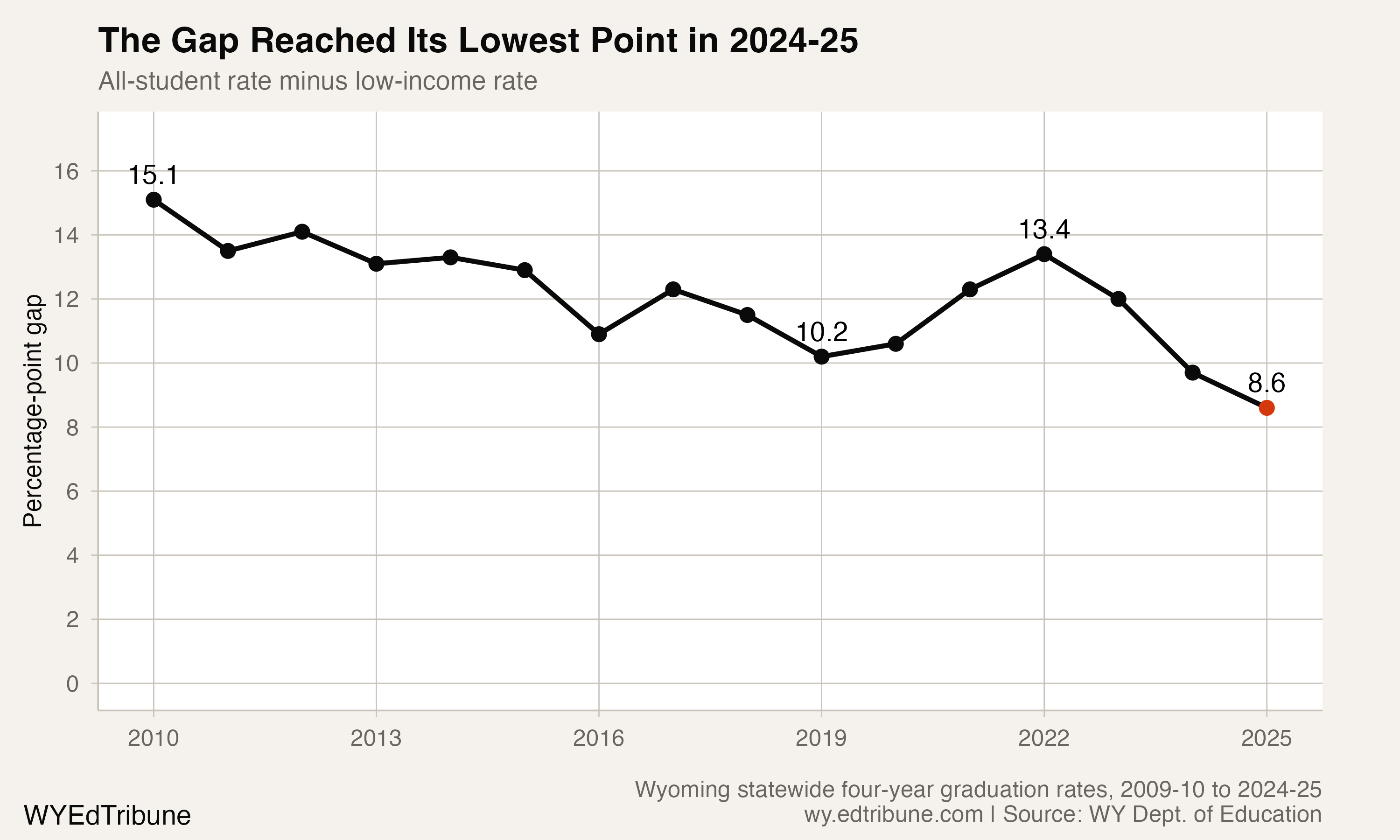
The difference between those two published rates narrowed from 15.1 percentage points to 8.6 points. That 6.5-point reduction occurred across a 15-year span and 16 annual observations.
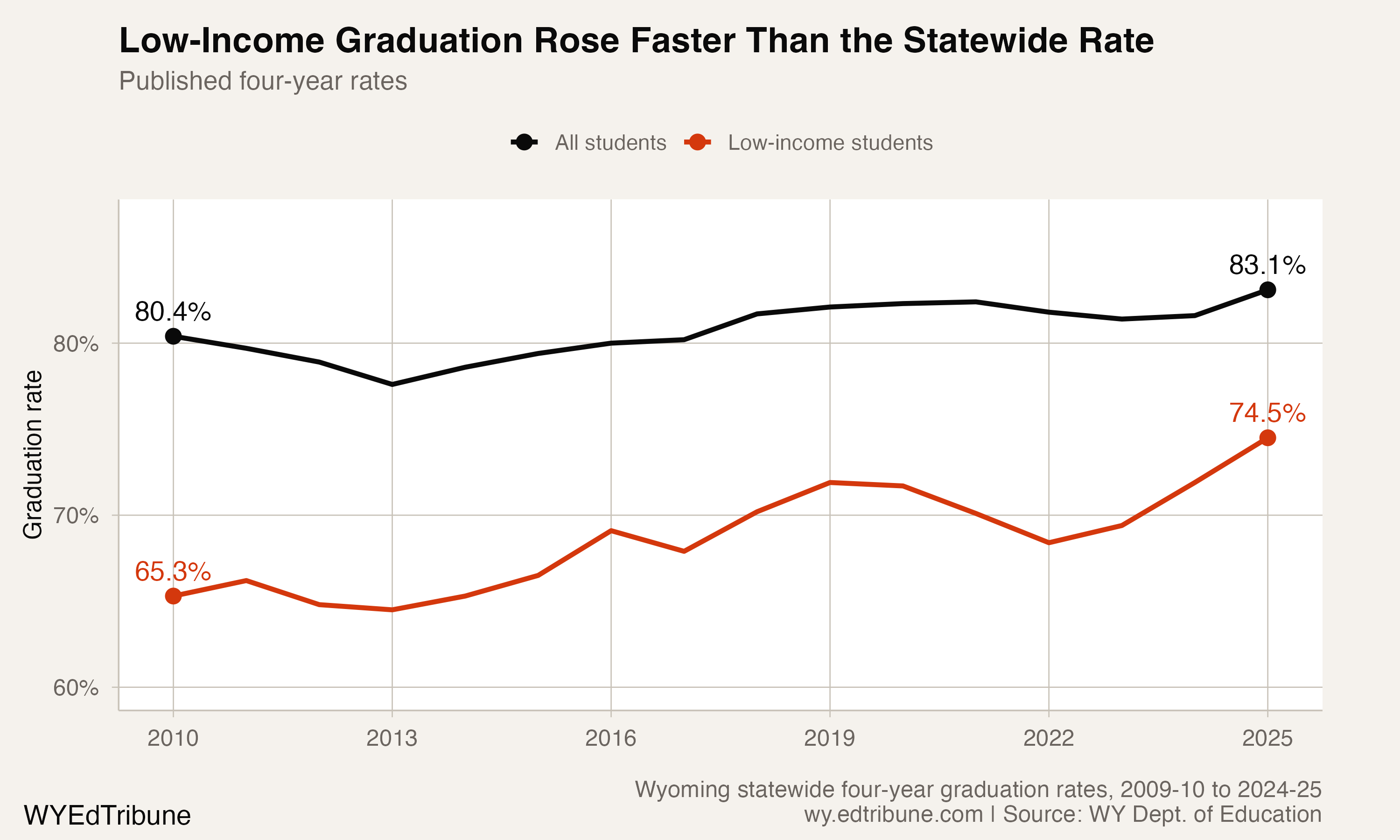
The low-income rate rose faster
The low-income rate gained 9.2 points between the endpoints. The all-student rate gained 2.7 points. Because the first increase was larger, the distance between the two rates shrank.
The path was not steady. The gap had fallen to 10.2 points by 2018-19, then widened to 13.4 points in 2021-22. It declined in each of the next three annual transitions, to 12.0, 9.7 and 8.6 points.
The 2024-25 gap was the smallest in the 16-observation series. The 74.5% low-income rate was also that subgroup's highest published rate in the series.
The latest result covered 3,597 students
The 2024-25 low-income cohort contained 3,597 students, of whom 2,678 graduated within four years. The statewide cohort contained 7,683 students and 6,385 four-year graduates.
Those counts establish the published rates. They do not establish how many additional students graduated because of a particular policy, program or change in conditions. The aggregate file does not identify a cause for the improvement.
What the gap measures
The 8.6-point figure subtracts the low-income rate from the all-student rate. The all-student group includes low-income students, so this is a benchmark difference—not a direct comparison between low-income and non-low-income students.
That distinction also means the gap cannot be multiplied by the latest cohort to produce a defensible estimate of "additional graduates." Such an estimate would require a valid counterfactual that the published aggregate series does not provide.
This analysis uses Wyoming Department of Education four-year adjusted-cohort graduation data from 2009-10 through 2024-25. The department publishes the series, files and methodology on its graduation rates page. The 2024-25 figures are last school year's results and the most recent published data in the package used here.
Detailed code that reproduces the analysis and figures in this article is available exclusively to EdTribune subscribers.
Discussion
Sign in to join the discussion.
Loading comments...